Showing posts with label afghanistan. Show all posts

Thursday, 2 April 2015

World Cup review - Group A

To everyone's surprise, the World Cup has now actually finished. This means we can now finally examine how it went for each of the competing teams, including those that most have probably forgotten about already. Also included is a review of our preview.


Afghanistan


Good: The very fact that a sporting team from Afghanistan is playing in a World Cup is a fantastic achievement. Watching them play, and watching their supporters revel in being there, was something that should not be forgotten any time soon. Even greater than that, though, was their first victory. Collapsing to a dismal 7/97 in a chase of 211, Samiullah Shenwari put the team on his back and, by sheer force of will, took them within twenty runs of the target. Hamid Hassan and Shapoor Zadran managed to overcome batting averages of five to take them home in the last over. If told that Hamid and Shapoor would be match winners, most would've expected them to be so with the ball, not the bat. Throughout the tournament the two bowled admirably, though perhaps without the reward they deserved.


Bad: If Afghanistan's bowling was admirable, their batting was anything but. Any team that gets to 3/3 facing Bangladesh is in a spot of bother. Any team averaging 17.17 for each wicket is not going to win too many games. Any team whose high scorer managed 254 runs, and whose next best less than half that, is going to rely almost entirely on their bowling. Samiullah Shenwari was the lone star in a misfiring batting line-up that probably cost them at least one match. Captain Mohammad Nabi's tournament also didn't help, as the team's fortunes were very much reliant on him, and he managed on 90 runs @ 15, and three wickets @ 87.


Ugly: Afghanistan's match against Australia was a great disappointment. The WACA was meant to be the perfect place for the Afghans to show off their skills with the ball, as the ground's bounce and pace would undoubtedly assist them. Unfortunately a combination of an unhelpful pitch, the new regulations, an opponent looking to make up for losing their last match, and their lack of experience turned the match into an absolute drubbing. The worst thing was that they didn't bowl particularly badly. They were simply bullied into submission.


Accuracy of our preview: Accurate, although the bowling wasn't quite match-winning.


Overall: A good learning experience for a team who should be in many World Cups to come. The fact that they might not be because of the big three is a travesty.


Australia


Good: Well, they won the World Cup. It's difficult to get much better than that. That aside, the bowling of Mitchell Starc was something to behold, understandably putting him atop the ODI rankings. The stats are something else: 22 wickets @ 10, with a strike rate of 17.4 and an economy of 3.4. Anyone who tipped that he would top the wickets tally would not have expected such a dominating performance. Glenn Maxwell's tournament could quite possibly define his career. His batting performances took Australia's totals out of reach, while his spin bowling was just useful enough to allows Australia to get away with not playing a spinner. Steve Smith continued his ridiculously good summer, after a slow start, scoring over 50 in every match from the WACA onwards.


Bad: If we say the modern era of ODI cricket began with the 1992 World Cup, then Australia have won four on the seven World Cups to have been played for in that time. Of those four teams, this seems like the weakest by a considerable margin. The squad members who aren't Maxwell, Smith and Starc had, at best, decent tournaments. The depth of the batting order allowed its fragility to become irrelevant, bar the loss to New Zealand. The potential weakness of only having three full time bowlers at any one time was made up for by the brilliance of Starc. As far as teams go, this is not a great one...but it is one that managed to win a World Cup, and do so convincingly.


Ugly: Has the Australian cricket team always been boorish? While the idea of the Australians playing hard but fair is as old as cricket, the ugliness that came to the fore during the early 2000s was back again in full force during the final. Worst of all, it was targeted at New Zealand, a team that has played in a way that all teams should aspire to. It is a good thing the Kiwis chose not to bite back, and is a sign of maturity that the Australians seem to sadly lack. That this behaviour is supported by many of the Australian public, especially vocal former players, is quite sad. The effect this is having on club cricket, especially in juniors, is deplorable.


Accuracy of our preview: Australia was about as good as we said they would be. Not great, but good enough.


Overall: Individual brilliance overcame the shortcomings of the squad.

Bangladesh
 
Good: Bangladesh overcame a poor run-up to the tournament to make the knockout stages again. Perhaps now, finally, we can say that they are beginning to fulfil their potential. It's not the first time that has been said, and they've still got a long way to go, but the first generation of academy cricketers are now hitting their prime. What was perhaps most promising was that this campaign was built on a solid batting lineup. Mahmudullah, Mushifiqur, Shakib and Sabbir all had great-to-good tournaments with the bat, something rarely seen from Bangladesh batting line-ups in days gone by. That they managed to chase down a 300+ total with ease suggests that there is also a greater maturity and confidence amongst the team. Soumya Sarkar didn't manage any great heights, but clearly demonstrated batting ability that will keep him in people's minds over the coming years.

Bad: The Deshi's strong middle order was able to make up for upper order brittleness. It's hard to tell whether it's worth moving Mushy and Shakib up the order to prevent an early collapse, because it comes with the risk that they themselves become a part of said collapse. In any case, it's still something that needs to be looked at. Also disappointing was the bowling. While this was hardly a bowlers' tournament, the lack of penetration from the bowling line-up was the difference between them being a genuine threat, and simply making up the numbers. While their spinners may have been more threatening at home, they desperately need this generation of fast bowlers to develop better than they have previously.

Ugly: There weren't really any truly low spots for the team on the field, although the direction the quarter-final went will probably stick in their memories for some time. But the bizarre behaviour of Mustafa Kamal, the ICC president, in questioning the motives of the umpiring during the quarter-final; complaining (probably justifiably) about not being the executive to hand over the World Cup; threatening to expose the ICC's actions; and finally resigning, all of which made for an unprofessional finish to a disappointing tournament.

Accuracy of our preview: Not very. Their batting seemed to have a fairly clear plan, and their bowling relied more on seamers than spinners. They also made it to the knockouts.

Overall: A promising stepping stone that must now be built upon.

England

Good: There was only one player who played well enough to fit here, and that was the maligned Ian Bell. While most believe Bell is a good Test player, the chopping and changing of his position over the years has led him to being placed as just an 'okay' limited overs player. But anyone who scores three fifties in six matches, with an average of 52, has had a decent tournament, and deserves to be applauded for at least providing some kind of stability in an unstable team.

Bad: Captain Eoin Morgan cut a forlorn figure after trudging off for a duck in the must-win match against Bangladesh. His five innings in the tournament went thusly: 0, 17, 46, 27, 0. He also made a duck in the second warm-up match, and the final of the tri-series. Perhaps the Irishman has been given too big a burden to bear, or at least a burden he had not enough time to prepare for. The other 'Mr Reliables' in Anderson and Broad also failed to have any impact on tournament, with Broad's record being particularly terrible. A strike bowler with a strike rate of 71 is not effective in any way.

Ugly: The puzzling switches made at the eleventh hour - after the tri-series but before the World Cup - made a mess of England's chances of doing anything significant. They reeked of a coach and selection panel who doubted themselves, and who doubted their ability to achieve what they had set out to do. The selection of Ballance, the moving of Taylor, the change of roles for Woakes and the non-selection of Tredwell and Bopara were all moves that did not seem right at the time, and seem no better looking back. England, not for the first time at a World Cup, seemed absolutely clueless about how they got into the position they did, and equally clueless about how to get out.

Accuracy of our preview: The bowling was spot on, but the batting was the exact opposite of what it should've been, and the fielding was of a side that was placing itself under pressure.

Overall: The sort of performance that should result in sweeping, positive changes, but probably won't.

New Zealand

Good: It would take almost as long as the World Cup to list all the good things that happened with New Zealand over the past six weeks. Their bowling was superb, their batting blitzed the opposition, their fielding was amazing, and the support the received from their countrymen and neutrals alike was unmatched. They played the game in a way every team should aspire to, and no-one would've begrudged them winning the tournament. But special mention should go to Trent Boult, who transformed from promising but somewhat unfulfilled limited overs bowler into a left arm machine, matching Starc as closely as anyone could hope to. He didn't quite have Starc's pace, but used guile and swing to decieve his opponents.

Bad: It may have been difficult to spot, but two players in the all-round excellent team did not have good tournaments. One was Luke Ronchi, who, when he got the chance to bat, did not get into double digits. A firing Ronchi may well have been the thing to elevate the Kiwis into a great team, but it was not to be. The other player was actually three players - Milne, McClenaghan and Henry. The third seamer simply wasn't able to have the same impact as Boult and Southee, although all three probably had different reasons for that. I suspect Henry would've had a good tournament if he'd been playing from game one, rather than coming in for the last two matches, but he didn't.

Ugly: The final was meant to be the showpiece event, a chance for the two best teams to demonstrate their brilliance. Instead, like most of the World Cup, it turned into an absolute drubbing, beginning with a fourth ball duck to captain Brendan McCullum and going mostly downhill from there. It was a great disappointment, and New Zealand will know that they won't get many chances to achieve a victory so sweet.

Accuracy of our preview: Correct.

Overall: The champions of hearts and minds, but not cold, hard reality.

Scotland

Good: There were little bright lights all over a haze of darkness that seems to hover over all Scottish World Cup efforts. Kyle Coetzer's 156 against Bangladesh would've been a match-winning performance at any other World Cup, and he and Matt Machan in particular demonstrated that Scotland has what it takes. Matthew Cross's skill with the gloves was unmatched and thoroughly enjoyable to watch. The king, though, was Josh Davey, who at one point led the overall wicket tally, and ended up 9th overall. The next best players to play only six matches were James Faulkner, Shapoor Zadran and Tendai Chatara at 20th. Davey isn't in any way fast, bowling in the 120s, but he knows where to put the ball in order to get wickets. His worst performance was 1/38 against Australia, never going wicketless. His performance should be enough to get him back into county cricket.

Bad: There's no looking past the fact that Scotland has still not won a World Cup match. Scotland put themselves in a winning position more than once, yet could not close out a match. There's no doubt that their lack of experience has worked against them, but to let Afghanistan win after having the 7/97 was simply not good enough, no matter how good Samiullah is. Both their batting and their bowling seemed fragile as well, relying on a select few to do well. While it's okay to expect Machan and Davey to perform, if they want to win regularly there needs to be all-round quality performances. Their batting and their bowling always seemed at least one short, and that may very well have been the difference between winning and losing.

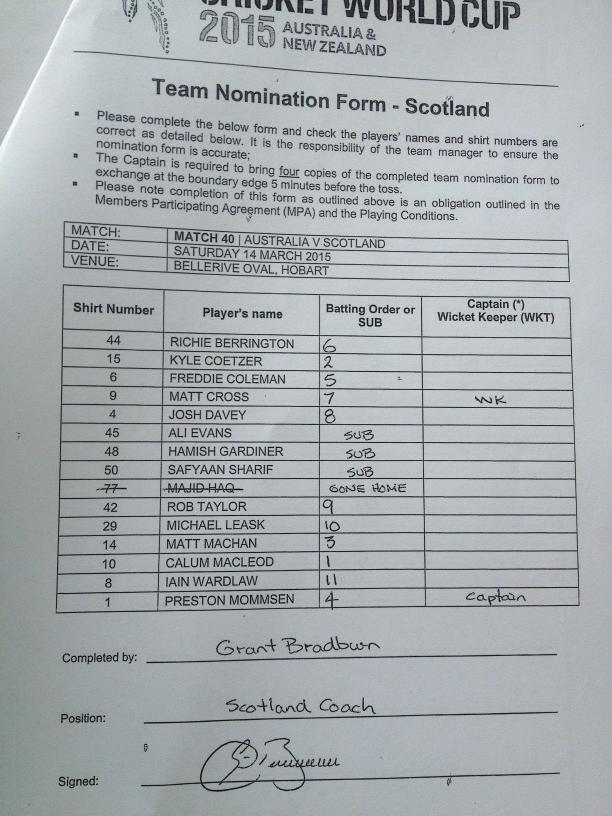
Ugly: Majid Haq had hypnotised us with his bowling when we first saw him bowl. The slowness with which he sends the ball down the pitch is something you're never going to see from the Test playing nations, and adds a bit more colour to what was otherwise a dull event. Unfortunately, Haq made a poor decision regarding colour of a different kind, suggesting via Twitter that his dropping for Michael Leask was based on colour. This tweet disappeared quickly, but Haq did as well, sent home before the last match, as Scotland made clear on their team sheet.

Accuracy of our preview: Not too bad at all. Davey was well and truly the surprise packet of the World Cup, and their batsman have a lot to learn.

Overall: A valuable experience, but in danger of being another false start if the big three have their way.

Sri Lanka

Good: Kumar Sangakkara is something special. While the batting in total did quite well, it was only able to do so due to Sanga's mastery of the willow. Four consecutive centuries, a feat not achieved at a World Cup before and may well not be achieved for many years to come, and yet he seemed to do it with ease. As, indeed, all his run scoring seems to be. It was a wonderful finale to his ODI career, and cricket will be poorer for not having him on the field for much longer. Joining him on the good performers list were the openers, Thirimanne and Dilshan. The two are at opposite ends of their careers, and have had the doubts that come with their respective ages, but those doubts disappeared with the weight of runs they scored.

Bad: It was a good thing their top order fired, because their middle order and bowling was as poor as the top order was good. Mathews had an okay tournament, but nothing like he's capable of. Malinga took his time to get going, and was firing in yorkers by the end, but he lacked support. Herath's injury disguised the fact he hadn't done too well to date. Overall, the middle and lower order failed when they were needed, on the rare occasions that the top order had done likewise, while the bowling simply didn't have the kind of impact the team would need to threaten the best. The next generation of bowlers will need to be far more impressive for Sri Lanka to continue as a great limited overs team.

Ugly: You would think the selectors would not even contemplate changing up the top order, given the strength of their performances during the group stages. But as is so often the case at SLC, they decided that they needed to bring in a new opener for their quarter final - someone who had played one match in the tournament, and hadn't done especially well. Poor old Kusal Perera was on a hiding to nothing, and the loss of his wicket for three set the standard for Sri Lanka in that match, losing by nine wickets.

Accuracy of our preview: Not even close, except for the result.

Overall: The last hurrah of the old, with four years now for the new brigade to cement themselves as being the right replacements.

Saturday, 14 March 2015

Book review - Second XI: Cricket in its Outposts

There's something about a World Cup that makes people look outside of their own time. Some may look back, reminiscing about past glories (especially for Australians) or past failures (especially for Englishmen). Some may look forward, wondering how the next World Cup might look, what should be changed, will it be any good?

It seems that this World Cup has tried to combine the two. There has been much written about the decision to turn the 2019 World Cup into an exclusive, ten team affair. The major justification used for it is that the best World Cup was supposedly held in 1992, and had a similar format to the one proposed.

It is with this background that Second XI: Cricket in its Outposts has been written. It is, as far as I'm aware, the first book ever to focus on a variety of national teams that don't play Test cricket, although there are a smattering of books on specific nations. It's primarily the work of Tim Wigmore, a prolific freelance writer whose work on Associate cricket over recent years has been outstanding, and Peter Miller, another freelancer, best known for his cricket podcast. There also contributions from Tim Brooks, Sahil Dutta, and the ubiquitous Gideon Haigh (which is by no means a bad thing).

The book contains, despite the name, ten chapters (like any second XI it's missing one, ho ho ho). There are four parts to the book: four chapters on the World Cup associates (Afghanistan, Ireland, Scotland, United Arab Emirates), two chapters on Associates that have since lost ODI status (Kenya, Netherlands), two chapters on rising Associates with strong homegrown talent (Nepal, Papua New Guinea), and two chapters on the potential gold mines (China, United States).

It's difficult to argue with the selections. While there are other teams that undoubtedly have stories worth telling - Canada and Bermuda have both fallen from grace in their own ways, while Hong Kong is the only current ODI nation without a chapter - these countries offer great variety. Each have their own unique stories to tell. 

Cricket in Ireland took far too long to get to the point it is now. Afghanistan is the great romantic story. Kenya is a sorry tale of corruption. The Netherlands is a sorry tale of a couple of bad days ruining the near future. The United States has managed to mangle its future countless times.

Very quickly, though, a common theme becomes apparent: development of the game in these outposts is clearly being hindered by the way the ICC and the full member nations are treating them. Why has Ireland played so few full members? Why has the Netherlands lost 'ODI status' and, with it, had years of hard work undone? Why was Kenya abandoned as soon as the 2003 World Cup was over? Why is Nepal not receiving any assistance from its neighbours? Why is the ICC so insistent on not joining the IOC?

The answer to all these questions seem to come down to the short-sightedness of the current administrators, who are insistent on maximising revenues gathered amongst themselves (something they are failing at too).

Each chapter does well to tell the tale of cricket in that country, charting the history of the game from its beginning to the modern day. Particular highlights are Wigmore's chapters on Ireland and Kenya, and Dutta's on China. Dutta paints a wonderful picture of the state of the game in a country where even the most basic concepts are completely foreign. The reproduction of Haigh's essay on cricket in PNG could be seen as disappointing, but it's a thoroughly readable piece. The UAE chapter is slightly short, but at the same time doesn't leave the sense that much is being left unsaid.

The overall tone is factual, without being dull; serious, without being morose; teaching, without being preachy; and with elements of levity, without being condescending. It's a tough balancing act, but it's done well.

Miller deserves kudos for his efforts to get some words out of Sultan Zarawani, immortalised in cricket history as the man who faced Allan Donald in a hat. Wigmore likewise for the less glorious find of Maurice Odumbe, accused and banned on account of corruption, who to this day protests his innocence. Haigh's tale contains a number of characters, the best of whom is the scene-stealing Luke, and none of whom you'd expect to meet in an essay on, say, the ECB.

Above all, Second XI is a great introduction into the world of Associate and Affiliate cricket. Anyone who enjoys cricket should read this book, as it will open up a world of vivid colours that contrast remarkably with the increasingly monochrome world of full member nations.

One quote summed up the latter best, whether in or out of context: "It makes no financial sense." - Giles Clarke, ECB.

Second XI: Cricket in its Outposts is out now. You can buy it here.

Thursday, 26 February 2015

Samiullah Shenwari, the warrior king

The Afghanistan national cricket team has been cricket's feel good story over the past few years. As they have continued to play and win at international level, more has been written about them.

The first player people paid attention to was Mohammad Shahzad. Afghanistan needed something to really make people take notice, and here was a batsman with talent, flair, and something called the 'helicopter shot'. When Afghanistan played in their first World T20, there he was, playing his shots, making people take notice. 

But Shahzad has been moved out of the first XI. Not because he isn't talented, or capable with the bat, but because he isn't fit enough. He has many years left to change this, but at the moment he seems to have been only the spark to get his nation noticed.

Next to be noticed was Hamid Hassan. Hassan is a classic fast bowler, sporting a headband and war paint. His focus is purely on taking wickets. He is probably the best bowler not playing Test cricket. He is an absolute joy to watch. But like a classic fast bowler, he gets injured regularly. So when Afghanistan is playing, he isn't always there.

So next was Mohammad Nabi. Nabi, unlike Shahzad and Hassan, is never out of the team. He is never injured, and does something important pretty much every match, either with a stabilising fifty, or an economical spell of off-spin. He's also their captain now. Nabi is the face of Afghan cricket, so how can you not pay attention to him?

The beauty of television has presented another Afghan player to the world: Shapoor Zadran. Shapoor is also a classic fast bowler, but in a different sense. If Hassan is a beast, then Shapoor is a beauty. He is magnificently tall, with glorious hair and a run-up that defies the modern age of precise science. He is an attention magnet.

So, that's four players to write about, four players to define Afghan cricket.

But there's one more player. One who has never had the attention these four have had. One who has made his way up the ranks from useful player to absolute necessity.

He is a player who demonstrates both aggression and calm, and seems able to use these both where appropriate, an absolutely vital attribute in international cricket. He has the heart of warrior, and the mind of a ruler.

His name is Samiullah Shenwari.

--------------------------------------------------

Shenwari played U17s for Afghanistan, along with many of his current national teammates. He was their high scorer in their loss to Oman at the ACC U17s Cup in 2004, and also took a wicket.

He played in the 2006 ACC Trophy in 2006. Sometimes he batted up the order, sometimes he batted down the order. Sometimes he would be ten overs and take a couple of wickets. Sometimes he wouldn't bowl at all. In the semi-final he batted at nine and did not bowl, in the third place play-off he batted at four and bowled five overs.

When Afghanistan began their push towards the 2011 World Cup in 2008, they were in division five of the World Cricket League. Afghanistan won the division. Shenwari scored two runs across three innings (batting at seven and eight), and bowled two balls. 

In division four, which Afghanistan won, he batted at eight and nine, scoring 49 runs in six matches. He also took three wickets. 

In division three, which Afghanistan came second in, he scored 113 runs in four innings, including a fifty, still batting at eight. He also took seven wickes.

Come the World Cup Qualifier, he was still batting at eight, scoring 194 runs, and bowling a bit, taking eight wickets.

When Afghanistan played their Intercontinental Cup match against the Netherlands, he batted at eight. When Afghanistan played their first ever ODI, against the same team, he batted at eight.

But then, in their second ODI, Shenwari got promoted to five in a search for quick runs. It worked, and Afghanistan chased down 232, with Shenwari scoring 30* off 39 deliveries.

He went back down to eight for their next ODIs and the first few matches of WCL division one. Then Afghanistan found themselves in a tight spot early against Kenya, so Shenwari came in at four. He scored a match winning 82 off 118.

Again, he went back down the order, mainly in the team for his useful leg-spin. But something had sparked, because every now and then he would come up from his position at eight or nine, and play a decent innings. Importantly, it was rarely a quickfire cameo. He was more likely to make his 30 at a strike rate of 60 than at a strike rate of 140.

By 2013 he had been nudged up to number seven, where he played a match winning innings of 81 against Bangladesh, and was pushed up to number six. After one innings there, he went back to eight. But the match-winner at seven may have been what caught the eye of the new Afghan coach.

Andy Moles arrived as Afghanistan's coach in 2014. Their first series following his appointment was against Zimbabwe. Shenwari found himself batting at five. And the thing was, he kept scoring runs. After Mohammad Nabi showed his batting to be just as reliable, they were swapped. But the two have stayed within one position of each other since then.

Then, in January 2015, Shenwari demonstrated everything that makes him so important to Afghanistan. They had defeated Scotland easily in the first match of a short tri-series. In the rematch, they fell apart, bowled out for 63, losing by 150 runs.

In Afghanistan's next match, Shenwari set about proving that Afghanistan could bat out a match, even if he had to do it himself. He ground out 50 from 96. Najibullah Zadran hit 83 from 50, an innings that won Afghanistan the match. Samiullah's innings seems unremarkable in comparison. But it was a foundation on which to build. That is what Shenwari does.

--------------------------------------------------

In a team that is renowned more for big hitting than grinding, Shenwari's application is an anomaly. He has a strike rate just under 70, despite an average of 38.51. This seems quite low. It seems even lower when you consider he's spent much of his career as a lower order batsman, in the team for his bowling more than his batting. His record batting up the order is actually quite remarkable: 754 runs @ 68.54. His lowest score at four is 38. At five he has made two single digit scores, and then a next lowest score of 39*. That is the kind of batting a team can build around.

It is the kind of batting that wins matches too.

When Shenwari came in at number four today against Scotland, Afghanistan were 2/45. With the help of Javed Ahmadi, Shenwari took the score to 2/85. Then, having just made his 50, Ahmadi had a wild swing at a Richie Berrington delivery, sent the ball in the air, and was out. The next four wickets fell for twelve runs. Shenwari could only calmly block, take singles and watch from the other end as the team fell around him.

Dawlat Zadran put on a 35 run partnership with Shenwari, before doing the same thing Ahmadi did, with the same result. Shenwari was livid. His calm demeanour was broken for those few seconds, and he seemed like the rest of his team - passionate and emotional. In many ways, Afghanistan seems like Pakistan from years ago.


But then he calmed again, reset, and got to working with the beast, Hamid Hassan. For the next twelve overs, the two set about bringing down the runs required. Hamid would block and leave and take the single where appropriate. Shenwari would do the same, but also take some boundaries from time to time. When he did this, it never seemed wild or out of control. It was always well controlled aggression. Despite the odds, Shenwari looked like he could single-handedly carry his team home.

Majid Haq came on in the 46th over, having gone for 26 off his first nine overs. Afghanistan needed 38 from 24. Haq came around the wicket to Shenwari for the first time in the match. 

The first ball was deposited over cow corner for six. 

The second ball was a wide. 

The third ball was mistimed for six over square leg.

The fourth ball was defended for no runs.

That is the difference with Shenwari. Most other Afghan batsmen would've tried another boundary. You cannot imagine Shahzad blocking a ball after hitting two sixes.

The fifth ball went for another six over mid wicket.

Haq came over the wicket.

The sixth ball was caught at deep mid wicket as Shenwari went for another six. He was on 96.

Shenwari seemed like his teammates again. After he walked of the field, he threw his bat down, and sat down with his helmet on, watching the game, distraught at getting out. Had he lost his team the game? Had that temporary rush of blood undone his 176 minutes at the crease?

Shenwari remained perched over the game until the end, hoping that two bowlers with batting averages of five could get his team home.

--------------------------------------------------

In the end, he won his team the game. Shapoor Zadran knocked a four from Iain Wardlaw off the third ball of the final over. Shapoor and Hassan sprinted towards the boundary, arms in the air, overjoyed at their victory.

All the photos that will be in the papers tomorrow, and in the history books detailing Afghanistan's first World Cup victory, will be of Shapoor with his arms aloft.

There won't be many of Shenwari. He wasn't there at the end. He didn't make a century. He didn't even bowl. But he did everything needed, and was the foundation of the innings.

He fought and scrapped and stayed in the contest, fighting even when he was on his haunches. He was a warrior.

But he was also cool and calm. When he scored boundaries, they were majestic. He was in control. You could believe that he would do the seemingly impossible. He was a king.

Were he only a stodgy batsman, he would not bowl leg spin. Using the wrist to spin the ball is more art than science.

But were he only an okay leg-spinner, he would not grind. He would not apply himself to every ball, waiting for the opportunity to put the team on his back.

He is something greater than that. He may even be something great.

So tonight, as the people of Afghanistan revel in their team's victory, we can imagine that they, at least, will be celebrating the heroics of the man who is now their greatest ever run scorer.

He is Samiullah Shenwari, warrior and king.