Showing posts with label review. Show all posts

Tuesday, 29 December 2015

Star Wars VII: The Force Awakens - The good, the bad and the ugly

Spoilers, obviously.

The Force Awakens has now been out for a week, breaking all kinds of records and capturing everyone's attention in the lead-up to Christmas, as though the Skywalkers have replaced the line of David.

After walking out of the cinema, it took me a while to figure out what I thought of the film. It was good, but in such a way that it felt like it could've been better if some fundamental changes had been made to the design of the film. Here are the good, the bad and ugly choices made in the making of Star Wars Episode VII.

Good

Poe Dameron: Despite the silly name (is he a ghost?), Poe is the best character in the entire film. A spectacularly talented fighter pilot, he puts his life on the line to take on the New Order time and again. He's cool under pressure, he knows exactly what he's doing, and we only see enough of him to know his characterisation is spot on. The total hand wave of his escape from Jakku when he reappears in the last third of the film feels justified, because he's just that kind of guy. 

Mixing and matching the roles from A New Hope: Rey, Finn and Poe are the Luke, Han and Leia of the new trilogy. But which one is which? Rey is the strong-willed female (Leia), who intrinsically knows everything about her ship (Han) that is the new talent in the Force upon whom events centre (Luke). Poe is a leader of the rebellion who needs to be rescued (Leia), by nature a bit of a playful scoundrel and has world experience (Han), who leads the attack on the Death Star Planet (Luke). Finn is the guy just wants to run away from everything (Han), who ends up being thrust into a central role in the rebellion (Luke), and I'm sure he has some similarity with Leia that hasn't come to mind - perhaps they were struggling a bit with it by this point. Overall, though, it's an impressive use of characters within the mould of A New Hope that they chose to use.

Han Solo: Second only to Poe in terms of best performances. When he arrives, it's unexpected (even though we knew he was coming at some point), and it's just he hasn't changed...other than that he's got old. He's still the same character, but full of the wisdom, experience, and regret that only age brings. Nothing throughout the film feels out of place with how you would expect an old Han Solo to be. 

Interaction between the new characters: Really well done, although from memory Poe only interacts with Finn, but that's okay because it's the best relationship of the lot. Rae and Finn both know absolutely nothing about the world they've rushed into, so in some ways it's not surprising that they become besties so quickly, even though it still felt forced (for reasons I'll explain later), the 'it' being the speed of that friendship, not the friendship itself. It was also refreshing to see what is clearly a budding romance begin without the two characters not liking each other. They have some misunderstandings, but only in the way you would expect given their backgrounds, and they get cleared quickly. How convenient, too, that young Ms Skywalker (as she so obviously is) will end up with a man with no last name, thus ensuring the name 'Skywalker' will continue on to another generation.

Killing off Han: There was no conceivable way all of the old three could make it through the new trilogy - not with the way this story has been set up. Using his death as the clear symbol of Kylo Ren's fall is classic storytelling. It's sad to see him go - especially this early, as I would've done it in VIII - but it was the right call. Luke or Leia dying would feel like a step too far, but Han? He's a scoundrel, it's natural for him to die first, and for him to do it by being the least like a scoundrel ever seen in the Star Wars films felt even better. 

Industrial Light and Magic: We're back to proper effects, which aren't going to age within a matter of years after the release of the film and don't exist in every nook and cranny imaginable. The graphical quality of the film speaks for itself. Just watch it and marvel.

Bad

Sticking to A New Hope like glue: This was the wrong choice. The intention seems clear: prove that the new Star Wars will be faithful to the original trilogy, and not flop like the prequels. Unfortunately they decided that the right way to do this was to copy literally every single piece of IV and use it in a slightly different way. Put the important map into a droid and sent it away, find it on a desert planet where the main character lives, have them encounter a wise old man who had disappeared for years, run into the rebellion, use what they've learnt to blow up a Death Planet which has successfully had its first test run, have the old mentor die at the hands of the evil man he turns out to be close to, have the main character successfully use the Force before getting away. Ta da! It would've been far better to do something different with the good characters they created.

Finn knows too much: If this guy, who as a character I generally like, was trained to be a Stormtrooper from birth/a young age, why does he seem so much like you and me? How he can he be so aware of things that the average person is aware of? How can he recognise right and wrong so easily? How can he play the role of comic relief so well in a way that is completely different to how the clone troopers have played it in other Star Wars media (that of being completely clueless of anything beyond fighting)? This is really noticeable in Finn, but it's actually true of everyone...

Why is everyone so human: This may seems like an odd complaint, but hear me out. I do not mean that it's a bad thing for them to be human in comparison to the prequels, because in those the characters were all robotic thanks to terrible decisions of direction (read: green screen everything). What I mean is that Star Wars is a space opera. It is not a realistic drama. I am meant to sympathise with the good guys and dislike the bad guys, like in a pantomime. The better the performances, the easier it is to do this, which is why it was so hard in the prequels. Even the complexity of good and evil (like a bad guy being good at heart) is meant to be relatively simple, ala Anakin coming back to the Light at the end. TFA ditched this in favour of complex, realistic, meant-to-be-relatable drama, and I don't like it at all. We see Kylo Ren struggling with the call of the light side. We see Finn explaining his feelings. We see everyone look like they're going to cry more than once. Why? This is meant to be a pantomime! What happened to the space opera?

What even is the Force: Seriously, what is it? Perhaps we never hear a proper explanation of it because the only characters who talk about it with any kind of knowledge are two non-Force users, but if you're coming into this film with no knowledge of the Force, you aren't going to come out much wiser. It seems to kind of help the way you fight, but not especially so, as we see two people use the Skywalker lightsabre with no Force knowledge whatsoever, and they don't die immediately - or at all. The Force has always been deliberately vague in a folk religion, mystical kind of way, but in TFA it was basically about closing your eyes and feeling better. Also, watching a guy thrust his hand out near someone's face for minutes on end is not thrilling viewing, please find a better way to symbolise what Ren is doing.

Rey is a Mary Sue: I want to like this character, but I can't, and I don't want to use the phrase 'Mary Sue', but what other way is there to describe this kind of character? Everything about her is perfect, including her one character flaw ('I want to go home'), which isn't really a character flaw at all, and which she gets over fairly quickly anyway. Pretty lady, very skilled hand-to-hand fighter, knows everything about spaceships and mechanics, everyone likes her, she picks up the whole Force powers thing basically straight away (though this can at least be hand-waved as 'she stole it from Kylo Ren') and everyone will drop everything for her wellbeing. Unlike Luke Skywalker, who, despite his circumstances, is an entirely believable head-in-the-clouds innocent figure, Rey (Skywalker) is an entirely unbelievable worldly figure who manages to hold on to only the most frustrating part of innocence (I can run away and it'll be fine). She even has a British accent, which strikes me as the kind of thing done to make a character seem different for no reason whatsoever. Remember, this is a pantomime made in the US, only evil characters should have British accents.

Ugly

Phasma: What a pointless character. How much of this character was not designed for monetary purposes? She is neither a strong female character (as obviously she was designed to be) nor a cool Boba Fett type (as she talks too much and is annoying in a way the Fetts aren't). I hope we never see her again (but we will).


The way they killed off Han: Could this have been any more excruciating? We knew this was coming. The hints were everywhere, and the moment Han saw Kylo is was over. He walked onto that bridge sealing his own fate. So why did it take so long? It would have been a far more memorable seen had it been over nice and quickly, without seeing Han slowly die and fall off the bridge, and everyone slowly react. The symbolism of 'this is the moment' would've come through more clearly too. This wasn't the first time that a moment was missed either - it only becomes apparent after his death that Leia's request to bring Kylo (Ben) home was what would lead to his death, because it was the only reason he confronted his son at all.

The ending: Who thought this was a good idea? In this case, following the Episode IV script closer would've resulted in something better. For example, a funeral for Han Solo, and then finish with an award ceremony for the fighters who blew up the planet, with a final cut shot of Luke Skywalker staring out over the waters from his island, zooming out to reveal his location, then cut to credits. Instead of this ending, which wraps things up and provides a tiny tease for the next film, we got something that felt rushed and haphazard, with an awkward pacing and an odd leap in the story. In particular, the final minute (which felt like five), which consisted of Rey holding Luke's lightsabre out to him while camera kept on panning around them, was genuinely excruciating and added nothing to the story. All we needed, if indeed we really needed to see the Jedi Master at all, was a quick shot to see that he was old, alone and isolated. Making this sequence so long added nothing to the film, and actually detracted from the events that had happened just prior. It would've been much better to spend more time on the death of quite possibly the most beloved character in the series, seeing how the other characters dealt with it in the aftermath, along with where the group headed from there.


Don't get me wrong, The Force Awakens is not a bad film. But it isn't great either. There is always the sense that this is a fanfiction brought to life just lurking in the background. Perhaps this is unsurprising, as I have no doubt most of the cast and crew are fans of the series, especially of the original trilogy. But the fact that this film is as good as it is ultimately results in a feeling of genuine disappointment, as there are simply too many significant issues in the film that prevent it from being great. This is not a film that I envision too many people ranking as their favourite Star Wars in twenty years from now, and that is a shame.

Sunday, 28 June 2015

What's so great about Inside Out?

I don't watch too many films, but when I went to see Inside Out, I was expecting something on par with some of Pixar's great films of the early-to-mid 2000s. With the exception of Cars, every single one of Pixar's films released between 2003 and 2010 received great acclaim critically, quite an achievement given they have released a film every year since 2003.

But for the past few years there have been murmurs of a rut in Pixar. The Good Dinosaur, which was meant to be last year's Pixar film, won't be coming out until late this year or early next year, depending on which part of the world you live in. Prior to that, Pixar's record was somewhat shaky. 2010's Toy Story 3 was regarded as one of their greatest films ever. 2011's Cars 2 was regarded as their worst, and 2013's Monsters University was seen as a decent effort at best. Their only non-sequel in this time, Brave, was also met with 'good-but-not-great' reviews.

So, with Inside Out receiving an average score on par with Toy Story 3, surely it must be a well handled, complex story for all ages, the kind of thing Pixar has been renowned for.

This is not so.

Let's be clear: the underlying theme behind the movie - that the constant pursuit of happiness is impossible and unhealthy - is one worth exploring. The way we, as a society, deal with emotions and their place in our life is a subject that we are no closer to solving now than we were fifty years ago, when the cultural revolutions of the west took place.

But it is also a difficult theme to explore, and while Pixar deserves credit for being willing to tackle such a theme, the overall plot and accompanying characterisation feel more superficial than they should.

The story consists of two worlds: the inner world of an eleven year old girl, Riley, which contains all her thoughts and is headed by a group of emotions; and the real world in which Riley lives. Riley's actions in the real world seem to be primarily, but not entirely, guided by her emotions. But this established order has some doubt cast over it by her move from Minnesota to San Francisco, which forms the basis of the story. This move causes inner turmoil for her and, therefore, for her emotions, which are unable to deal with the new circumstances which she is in (thus raising the question of whether the emotions are actually in control, something that is never really addressed). 

And then Joy, Sadness and all Riley's core memories get sucked up a pipe.

This is somewhat of a spoiler, but this one event sets the course for the rest of the movie, and is therefore responsible for the incredible frustration that is the middle act of this film. Unlike past Pixar films, which all take place in real locations - the suburbs of the US, the ocean, Paris, space, etc. - the main setting for this film is entirely imaginary. When we see an enormous structure in this setting, such as the islands of thought, there is no sense of wonder. After all, it did not take any effort to 'build' that structure, they simply appear. There is no real sense of scale either. We have no idea how long it might take to walk from one side of the brain to the other, so whenever the main characters manage to just miss getting on their path back to headquarters, it brings only frustration. The sense builds that every failure is simply being contrived to draw out the middle act. The train line collapses after being hit by debris from a falling island! The pipes to headquarters break because the structure they are built into is falling apart! The wagon that flies on the power of music doesn't quite have enough fuel to reach the top of the cliff! None of these events feel real. There is no sense that yes, these things could actually happen, and therefore it is logical for them to have occurred here. Of course, animated films always have some leeway with what could or could not occur, but in this case there is absolutely nothing to draw upon.

This all means that the plot feels directionless, made purely to draw out time in the film between the decent opening act and the enjoyable but short final act.

Perhaps this lack of direction is a reflection on the lack of an antagonist, which seems like a missed opportunity. There are five emotions which are meant to be living in our minds - joy, sadness, fear, disgust and anger - and yet all of them play the role of protagonist to some degree or another. There are no antagonists in the outside world either. Perhaps the idea of chaos is meant to be the antagonist, but the chaos of childhood is presented in such a positive light that this seems far-fetched as well.

In fact, perhaps the character best suited to playing the role of antagonist is one of the primary protagonists: Joy. Now, it may seem a bit churlish to complain about a character than personifies an emotion constantly embodying that emotion, but the problems with Joy's character run deeper than her constant happy-go-lucky nature. The biggest problem is how long it takes for her to learn anything. She spends three-quarters of the movie assuming that the other emotions - Sadness in particular - are inferior to herself, and less necessary. While there is an argument to make that such a belief is the truth, what it means for the story is that her sudden turnaround towards Sadness in the last part of the movie feels as though it lacks depth. Furthermore, it is difficult to be sympathetic towards her, as some of her actions seem genuinely cruel and selfish. She never bothers to properly explain her actions to any of the others, and yet all the other characters just accept this happening.

The second primary protagonist is Sadness. Unlike Joy, Sadness is easier to sympathise with, as she is normally the victim, and she is responsible for probably the most genuinely moving moment within the inner world. This moving moment is with Bing Bong, the imaginary friend of Riley that represents her disappearing childhood. Joy, too, has a moment intended to be of similar poignancy with Bing Bong, but it falls entirely flat thanks to how difficult it is to connect with both Joy and Bing Bong, and to how suddenly yet inevitably it occurs. But while Sadness has these strengths, she simply doesn't get the time on screen she needs to be an actual major character, and also never gets the chance to really explain herself and her actions, though not for want of trying. The characterisation of the two protagonists is also somewhat bothersome. Joy is a happy-go-lucky action girl, and Sadness is a shy bookworm. The underlying (presumably unintended) message being that those who aren't eager to be out and about all the time must be naturally less happy than those who are. It's a simple characterisation, but that does not make it less grating.

The other three emotions play secondary roles, but are all portrayed sympathetically, which seems to me to be an odd choice. Anger, especially, seems like a character ripe for the role of antagonist. Every decision that he makes is shown to have bad consequences for Riley and those around her. But despite this, Anger is used mostly as comic relief, which is admittedly done well. But surely, in a film which explores which emotions are worth feeling, there should be a recognition that anger is actually a dangerous emotion which is rarely used well. Fear is probably the most well used emotion, coming in where appropriate, such as early on when he saves Riley from falling over a power cord. Disgust, on the other hand, is a peculiar character, seemingly taking on the idea of social interaction more broadly. I'm not entirely sure what name would've been more apt for the character, but 'disgust' doesn't quite seem to fit.

The human characters are fairly stock-standard, as is perhaps necessary given they provide the setting and context, rather than being important characters in and of themselves. At least part of the praise for this movie has come from the moments between daughter and parent, but for the purposes of this article it is neither here nor there.

There is one other character worth looking at. I mentioned Bing Bong earlier, and how it was difficult to connect with him. In truth this is not because the character is difficult to sympathise with, but because I genuinely don't know what to make of the character. Being an entirely imaginary creature, his looks are complex, and this is also true of his character. Here is a naturally joyful, goofball character that is now lost, existing in the mind of a child that has outgrown him. I actually want to like the character, and at times I do, but then I think it over again and I return to not liking him. I doubt I will ever figure this out.

These flaws are, to my mind, what prevent Inside Out from being a genuinely great film. So why, then, have reviews been so glowing?

I suspect there are two reasons which are working in tandem. Firstly, reviewers love the idea of the film, a film about the emotions that we all feel, and how we are meant to feel them in a world where we are constantly called upon to be happy. Second, we want Pixar to be great again. Anything which feels like a step towards this will likely be treated as though it is indeed a return. The danger of this is that, should Pixar genuinely make something of such quality in the next few years, there is only so many ratings points left for them.

This is not intended to be an even-handed critique, as there are still many things the film does well. I just find it odd that the film is being so highly lauded, when, to my eyes, it does not reach the heights of past Pixar films.

Thursday, 2 April 2015

World Cup review - Group A

To everyone's surprise, the World Cup has now actually finished. This means we can now finally examine how it went for each of the competing teams, including those that most have probably forgotten about already. Also included is a review of our preview.


Afghanistan


Good: The very fact that a sporting team from Afghanistan is playing in a World Cup is a fantastic achievement. Watching them play, and watching their supporters revel in being there, was something that should not be forgotten any time soon. Even greater than that, though, was their first victory. Collapsing to a dismal 7/97 in a chase of 211, Samiullah Shenwari put the team on his back and, by sheer force of will, took them within twenty runs of the target. Hamid Hassan and Shapoor Zadran managed to overcome batting averages of five to take them home in the last over. If told that Hamid and Shapoor would be match winners, most would've expected them to be so with the ball, not the bat. Throughout the tournament the two bowled admirably, though perhaps without the reward they deserved.


Bad: If Afghanistan's bowling was admirable, their batting was anything but. Any team that gets to 3/3 facing Bangladesh is in a spot of bother. Any team averaging 17.17 for each wicket is not going to win too many games. Any team whose high scorer managed 254 runs, and whose next best less than half that, is going to rely almost entirely on their bowling. Samiullah Shenwari was the lone star in a misfiring batting line-up that probably cost them at least one match. Captain Mohammad Nabi's tournament also didn't help, as the team's fortunes were very much reliant on him, and he managed on 90 runs @ 15, and three wickets @ 87.


Ugly: Afghanistan's match against Australia was a great disappointment. The WACA was meant to be the perfect place for the Afghans to show off their skills with the ball, as the ground's bounce and pace would undoubtedly assist them. Unfortunately a combination of an unhelpful pitch, the new regulations, an opponent looking to make up for losing their last match, and their lack of experience turned the match into an absolute drubbing. The worst thing was that they didn't bowl particularly badly. They were simply bullied into submission.


Accuracy of our preview: Accurate, although the bowling wasn't quite match-winning.


Overall: A good learning experience for a team who should be in many World Cups to come. The fact that they might not be because of the big three is a travesty.


Australia


Good: Well, they won the World Cup. It's difficult to get much better than that. That aside, the bowling of Mitchell Starc was something to behold, understandably putting him atop the ODI rankings. The stats are something else: 22 wickets @ 10, with a strike rate of 17.4 and an economy of 3.4. Anyone who tipped that he would top the wickets tally would not have expected such a dominating performance. Glenn Maxwell's tournament could quite possibly define his career. His batting performances took Australia's totals out of reach, while his spin bowling was just useful enough to allows Australia to get away with not playing a spinner. Steve Smith continued his ridiculously good summer, after a slow start, scoring over 50 in every match from the WACA onwards.


Bad: If we say the modern era of ODI cricket began with the 1992 World Cup, then Australia have won four on the seven World Cups to have been played for in that time. Of those four teams, this seems like the weakest by a considerable margin. The squad members who aren't Maxwell, Smith and Starc had, at best, decent tournaments. The depth of the batting order allowed its fragility to become irrelevant, bar the loss to New Zealand. The potential weakness of only having three full time bowlers at any one time was made up for by the brilliance of Starc. As far as teams go, this is not a great one...but it is one that managed to win a World Cup, and do so convincingly.


Ugly: Has the Australian cricket team always been boorish? While the idea of the Australians playing hard but fair is as old as cricket, the ugliness that came to the fore during the early 2000s was back again in full force during the final. Worst of all, it was targeted at New Zealand, a team that has played in a way that all teams should aspire to. It is a good thing the Kiwis chose not to bite back, and is a sign of maturity that the Australians seem to sadly lack. That this behaviour is supported by many of the Australian public, especially vocal former players, is quite sad. The effect this is having on club cricket, especially in juniors, is deplorable.


Accuracy of our preview: Australia was about as good as we said they would be. Not great, but good enough.


Overall: Individual brilliance overcame the shortcomings of the squad.

Bangladesh
 
Good: Bangladesh overcame a poor run-up to the tournament to make the knockout stages again. Perhaps now, finally, we can say that they are beginning to fulfil their potential. It's not the first time that has been said, and they've still got a long way to go, but the first generation of academy cricketers are now hitting their prime. What was perhaps most promising was that this campaign was built on a solid batting lineup. Mahmudullah, Mushifiqur, Shakib and Sabbir all had great-to-good tournaments with the bat, something rarely seen from Bangladesh batting line-ups in days gone by. That they managed to chase down a 300+ total with ease suggests that there is also a greater maturity and confidence amongst the team. Soumya Sarkar didn't manage any great heights, but clearly demonstrated batting ability that will keep him in people's minds over the coming years.

Bad: The Deshi's strong middle order was able to make up for upper order brittleness. It's hard to tell whether it's worth moving Mushy and Shakib up the order to prevent an early collapse, because it comes with the risk that they themselves become a part of said collapse. In any case, it's still something that needs to be looked at. Also disappointing was the bowling. While this was hardly a bowlers' tournament, the lack of penetration from the bowling line-up was the difference between them being a genuine threat, and simply making up the numbers. While their spinners may have been more threatening at home, they desperately need this generation of fast bowlers to develop better than they have previously.

Ugly: There weren't really any truly low spots for the team on the field, although the direction the quarter-final went will probably stick in their memories for some time. But the bizarre behaviour of Mustafa Kamal, the ICC president, in questioning the motives of the umpiring during the quarter-final; complaining (probably justifiably) about not being the executive to hand over the World Cup; threatening to expose the ICC's actions; and finally resigning, all of which made for an unprofessional finish to a disappointing tournament.

Accuracy of our preview: Not very. Their batting seemed to have a fairly clear plan, and their bowling relied more on seamers than spinners. They also made it to the knockouts.

Overall: A promising stepping stone that must now be built upon.

England

Good: There was only one player who played well enough to fit here, and that was the maligned Ian Bell. While most believe Bell is a good Test player, the chopping and changing of his position over the years has led him to being placed as just an 'okay' limited overs player. But anyone who scores three fifties in six matches, with an average of 52, has had a decent tournament, and deserves to be applauded for at least providing some kind of stability in an unstable team.

Bad: Captain Eoin Morgan cut a forlorn figure after trudging off for a duck in the must-win match against Bangladesh. His five innings in the tournament went thusly: 0, 17, 46, 27, 0. He also made a duck in the second warm-up match, and the final of the tri-series. Perhaps the Irishman has been given too big a burden to bear, or at least a burden he had not enough time to prepare for. The other 'Mr Reliables' in Anderson and Broad also failed to have any impact on tournament, with Broad's record being particularly terrible. A strike bowler with a strike rate of 71 is not effective in any way.

Ugly: The puzzling switches made at the eleventh hour - after the tri-series but before the World Cup - made a mess of England's chances of doing anything significant. They reeked of a coach and selection panel who doubted themselves, and who doubted their ability to achieve what they had set out to do. The selection of Ballance, the moving of Taylor, the change of roles for Woakes and the non-selection of Tredwell and Bopara were all moves that did not seem right at the time, and seem no better looking back. England, not for the first time at a World Cup, seemed absolutely clueless about how they got into the position they did, and equally clueless about how to get out.

Accuracy of our preview: The bowling was spot on, but the batting was the exact opposite of what it should've been, and the fielding was of a side that was placing itself under pressure.

Overall: The sort of performance that should result in sweeping, positive changes, but probably won't.

New Zealand

Good: It would take almost as long as the World Cup to list all the good things that happened with New Zealand over the past six weeks. Their bowling was superb, their batting blitzed the opposition, their fielding was amazing, and the support the received from their countrymen and neutrals alike was unmatched. They played the game in a way every team should aspire to, and no-one would've begrudged them winning the tournament. But special mention should go to Trent Boult, who transformed from promising but somewhat unfulfilled limited overs bowler into a left arm machine, matching Starc as closely as anyone could hope to. He didn't quite have Starc's pace, but used guile and swing to decieve his opponents.

Bad: It may have been difficult to spot, but two players in the all-round excellent team did not have good tournaments. One was Luke Ronchi, who, when he got the chance to bat, did not get into double digits. A firing Ronchi may well have been the thing to elevate the Kiwis into a great team, but it was not to be. The other player was actually three players - Milne, McClenaghan and Henry. The third seamer simply wasn't able to have the same impact as Boult and Southee, although all three probably had different reasons for that. I suspect Henry would've had a good tournament if he'd been playing from game one, rather than coming in for the last two matches, but he didn't.

Ugly: The final was meant to be the showpiece event, a chance for the two best teams to demonstrate their brilliance. Instead, like most of the World Cup, it turned into an absolute drubbing, beginning with a fourth ball duck to captain Brendan McCullum and going mostly downhill from there. It was a great disappointment, and New Zealand will know that they won't get many chances to achieve a victory so sweet.

Accuracy of our preview: Correct.

Overall: The champions of hearts and minds, but not cold, hard reality.

Scotland

Good: There were little bright lights all over a haze of darkness that seems to hover over all Scottish World Cup efforts. Kyle Coetzer's 156 against Bangladesh would've been a match-winning performance at any other World Cup, and he and Matt Machan in particular demonstrated that Scotland has what it takes. Matthew Cross's skill with the gloves was unmatched and thoroughly enjoyable to watch. The king, though, was Josh Davey, who at one point led the overall wicket tally, and ended up 9th overall. The next best players to play only six matches were James Faulkner, Shapoor Zadran and Tendai Chatara at 20th. Davey isn't in any way fast, bowling in the 120s, but he knows where to put the ball in order to get wickets. His worst performance was 1/38 against Australia, never going wicketless. His performance should be enough to get him back into county cricket.

Bad: There's no looking past the fact that Scotland has still not won a World Cup match. Scotland put themselves in a winning position more than once, yet could not close out a match. There's no doubt that their lack of experience has worked against them, but to let Afghanistan win after having the 7/97 was simply not good enough, no matter how good Samiullah is. Both their batting and their bowling seemed fragile as well, relying on a select few to do well. While it's okay to expect Machan and Davey to perform, if they want to win regularly there needs to be all-round quality performances. Their batting and their bowling always seemed at least one short, and that may very well have been the difference between winning and losing.

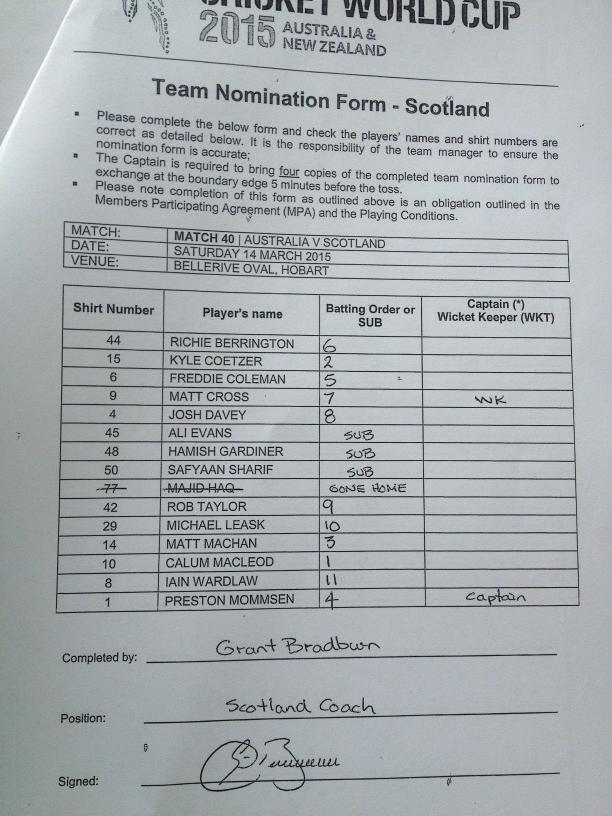
Ugly: Majid Haq had hypnotised us with his bowling when we first saw him bowl. The slowness with which he sends the ball down the pitch is something you're never going to see from the Test playing nations, and adds a bit more colour to what was otherwise a dull event. Unfortunately, Haq made a poor decision regarding colour of a different kind, suggesting via Twitter that his dropping for Michael Leask was based on colour. This tweet disappeared quickly, but Haq did as well, sent home before the last match, as Scotland made clear on their team sheet.

Accuracy of our preview: Not too bad at all. Davey was well and truly the surprise packet of the World Cup, and their batsman have a lot to learn.

Overall: A valuable experience, but in danger of being another false start if the big three have their way.

Sri Lanka

Good: Kumar Sangakkara is something special. While the batting in total did quite well, it was only able to do so due to Sanga's mastery of the willow. Four consecutive centuries, a feat not achieved at a World Cup before and may well not be achieved for many years to come, and yet he seemed to do it with ease. As, indeed, all his run scoring seems to be. It was a wonderful finale to his ODI career, and cricket will be poorer for not having him on the field for much longer. Joining him on the good performers list were the openers, Thirimanne and Dilshan. The two are at opposite ends of their careers, and have had the doubts that come with their respective ages, but those doubts disappeared with the weight of runs they scored.

Bad: It was a good thing their top order fired, because their middle order and bowling was as poor as the top order was good. Mathews had an okay tournament, but nothing like he's capable of. Malinga took his time to get going, and was firing in yorkers by the end, but he lacked support. Herath's injury disguised the fact he hadn't done too well to date. Overall, the middle and lower order failed when they were needed, on the rare occasions that the top order had done likewise, while the bowling simply didn't have the kind of impact the team would need to threaten the best. The next generation of bowlers will need to be far more impressive for Sri Lanka to continue as a great limited overs team.

Ugly: You would think the selectors would not even contemplate changing up the top order, given the strength of their performances during the group stages. But as is so often the case at SLC, they decided that they needed to bring in a new opener for their quarter final - someone who had played one match in the tournament, and hadn't done especially well. Poor old Kusal Perera was on a hiding to nothing, and the loss of his wicket for three set the standard for Sri Lanka in that match, losing by nine wickets.

Accuracy of our preview: Not even close, except for the result.

Overall: The last hurrah of the old, with four years now for the new brigade to cement themselves as being the right replacements.