Back in December I gave my thoughts on the future of West Indies cricket, during their embarrassing tour of Australia. It wasn't a positive outlook, particularly for the notion of the 'West Indies' continuing as one team.
For much of the cricketing world, their first ever success in the Under-19s World Cup is a much needed sign of something blooming in the West Indies, a sign that maybe, just maybe, things were looking up for cricket in the region. Well, I don't mean to be a downer (even if I did, Tony Cozier got there first), but this seems unlikely.
I said in December that 'the biggest problem facing the Windies is not talent.' This is evidently true, else they would not have won this World Cup. Talent has not ever, and will never, be a problem for the islands of the Caribbean. To be honest, I doubt talent is really, truly much of a problem in any country at all. Cricket is the kind of sport that really only needs a small amount of gems to create something magnificent.
As such, this win is not a sign of a turn-around in the administration or coaching of cricket across the islands. If anything, it can be attributed to the right circumstances coming at the right time. If we hold, as I do, that disunity is the fundamental problem with the West Indies, then clearly the solution is to unite them again. So, can you think of anything that happened during the U19 WC that could have united this team?
I can.
Their win over Zimbabwe.
It is unfair on mankading to call the end of that game a mankad, but whatever it actually was, it brought the ire of the majority of the cricket community on their young heads. The language of some of said ire was actually just as poor as the incident itself, and it seems to me that few things can unite a group as much as unfair criticism (perceived or real) being heaped upon them. Keep in mind, prior to this the team had been far from impressive, with just a loss to England and an untidy win over the out-of-their-depth Fiji to their name. Prior to that they had been whitewashed by the Bangladesh U19s in a pre-tournament series. Not exactly the form of a world champion.
But after the win over their poorer full member cousins (as amazing as it is that there can be teams poorer than them), the team just seemed to click. Everything started working, and nothing could stop them. They were, like the Windies teams of old, united.
But this doesn't really mean much in the long run. It's the most short-term solution you can imagine: a one-off event for a tournament most of them will never play in again, though hopefully many will end up playing in the full version in the years to come.
It does nothing to address the fundamental issues facing the senior players, a group they will soon join. It does nothing to address the fundamental issue of total disunity at the (inter)national level. If some of these players get thrown into the national squad straight away, the likely result would be another generation of players thrown away to a war that can't be won.
It's not as though the disputes between players and board have gone away. They're right there, looming over the World T20, just waiting for another chance to interfere in the playing of international cricket.
So all the best to the winning Windies, I hope they savour the victory. But I suspect many of these young men will end up playing international cricket in colours other than maroon.
(As an aside, these are the nations that these players divided into:
Antigua and Barbuda: Alzarri Joseph
Barbados: Chemar Holder, Shamar Springer
Grenada: Ryan John, Emmanuel Stewart
Guyana: Shimron Hetmeyer, Tevan Imlach, Keemo Paul
Jamaica: Shahid Crooks, Michael Frew, Odean Smith
Saint Vincent and the Grenadines: Obed McCoy, Gidron Pope
Sint Maarten: Keacy Carty
Trinidad and Tobago: Jyd Goolie, Kirsten Kallicharan)
Showing posts with label cricket world cup. Show all posts
Showing posts with label cricket world cup. Show all posts
Thursday, 18 February 2016

Thursday, 9 April 2015
World Cup review - Group B
To everyone's surprise, the World Cup
has now actually finished. This means we can now finally examine how it
went for each of the competing teams, including those that most have
probably forgotten about already. Also included is a review of our preview.
Group A is here.
India
Good: To call India's performance a surprise would be an understatement. Despite being the reigning champions, they'd spent the whole summer being bashed from pillar to post by Australia and even England, and there was no real reason to believe this would change. Instead they went undefeated until their semi-final against Australia. That their batting was strong was not a surprise, but that their bowling should turn around from incapable to irresistible was quite the shock. The pace attack of Yadav, Shami and Sharma had enough points of difference to be an effective partnership, while spinners Ashwin and Jadeja kept the run rate down and the pressure on during the middle overs.
Bad: It's surprisingly hard to find a weak spot in a team that didn't win the World Cup, but if it was anywhere it was in the middle order. Bear in mind that this was a middle order that wasn't often needed, due to the strength of the top three, but even then they seemed a bit unsure of themselves. Rahane made one score over fifty, Raina was all or nothing, Dhoni did not have the same impact as he did a few years ago and Jadeja did absolutely nothing with the bat. It was perhaps this weakness that saw them unable to chase down the Australian total in the semi-final, guided by a less-than-100% Dhoni, who took too long to get started in the chase proper, and had no-one to help him.
Ugly: India's occasional move towards constant sledging reared its head again occasionally, but far worse was not the Indian team, but the representative of the BCCI, out on the world stage telling everyone how inclusive the tournament was, and how great the numbers were. I am, of course, talking about N Srinivasan, leader of the big three. Few have been such a disservice to cricket in both India and the world.
Accuracy of our preview: Not even close.
Overall: A professional performance from a well-prepared team.
Ireland
Good: Once again, Ireland proved that it deserves to be playing cricket at the highest level regularly, defeating two full member nations by scoring over 300. The strength of their batting was evident in that only one of their top seven did not play in the 2011 World Cup, and their experience shone through against opponents of similar ability (UAE and Zimbabwe). That one new player, Andy Balbirnie, also had a great tournament, building to a crescendo with his 97 against Zimbabwe. His inexperience did show in his innings against India and Pakistan, but he is undoubtedly a great talent for the future. With the ball, Alex Cusack performed admirably, battling against a body that would prefer not to be playing.
Bad: While Ireland's batting was mostly on song, their bowling was not. Comfortably the most expensive bowling line-up in the tournament, Ireland's failure to hold their opposition back placed an enormous amount of pressure on their batting to perform, which cost them dearly against Pakistan, and in the end caused their net run-rate to collapse. Paul Stirling's tournament wasn't the greatest, despite a 92 to start against the West Indies. While he is often hit and miss, the rate of misses leans too high for someone opening the batting. Gary Wilson also struggled with the bat, and it seems difficult to justify his selection in the one day team when another keeper is in the team. While Wilson is probably Ireland's next captain, he isn't the captain right now, so his spot should be up for grabs.
Ugly: The degree to which Ireland's bowling suffered needs to be emphasised here. In particular, the selection of all-rounders instead of bowlers to lead the pace attack was absolutely absurd when there were two young, promising pace bowlers in the squad (Craig Young and Peter Chase). Scotland's Josh Davey had demonstrated his effectiveness, purely from knowing where to put the ball, so it's hard to believe Young especially wouldn't have had a similar tournament. Instead, most of the pace bowling was done by all-rounders, who seemed more comfortable containing than taking wickets. This was not a World Cup in which to be a containing bowler, because it was more or less impossible. Kevin O'Brien indifferent form with the bat was undoubtedly due, at least in part, to his form with the ball, forced into playing a role he is clearly not entirely comfortable with or best suited to doing. A new coach should bring renewed opportunities for the pace duo, but they have been robbed of World Cup experience.
Accuracy of our preview: Not great. The batting was far greater, not lesser, than the bowling.
Overall: A tournament demonstrating their ability that the ICC will do its best to ignore.
Pakistan
Good: The depth of Pakistan's bowling almost defies belief. With no Umar Gul, Junaid Khan, Saeed Ajmal or Mohammad Hafeez, it was expected Pakistan's bowling, combined with their already struggling batting, would see them drop out with barely a whimper. Instead they changed their bowling plans and told their replacements bowlers to go for it. Irfan, Wahab, Sohail and Rahat provided a non-stop pace threat that consistently threatened and often succeeded in limiting their opponents through a mixture of pace and swing. With the bat, Misbah was up to his usual high standard, while Sarfraz Ahmed did well once he was given a chance.
Bad: It's not too surprising that Misbah thought 250 was a defendable total given the batting line-up Pakistan had to work with. It is as though they are playing in a different era to all the other teams. Their batting is slow, inconsistent and lacking in the kind of match-winning performance that a team needs if it expects to win. Nasir Jamshed's tournament was particularly poor, scoring five runs across three innings, setting the tone for the rest of the innings. Pakistan will need to totally rework their approach to limited overs cricket if they want to win. Their fielding, as always, was not up to scratch, which seems to be indictment on the facilities they have domestically.
Ugly: While their batting throughout the tournament was poor, nothing summed up their paucity of runs more than when they dropped to 4/1 against the West Indies. Yes, that is four wickets for one run. Against a team that was comprehensively dismantled by Ireland in their previous match. That they managed to recover to give Australia a fright in the quarter-final is a credit to their bowling, not their batting.
Accuracy of our preview: No. Their bowling depth is far deeper than predicted.
Overall: Incredible bowling depth only able to take a team so far.
South Africa
Good: It was fairly clear before the tournament began that South Africa's fortunes would rest in the hands of a few individuals. In the end, that was exactly what happened. It the performance of four players that kept them going: AB de Villiers and Faf du Plessis with the bat; Morne Morkel and Imran Tahir with the ball. De Villiers is in the form of his life, so to see him crunching 482 runs at an average of 96.4 seems almost ordinary. This is someone with an incredible eye, a great technique and an aggressive mindset. This is someone who will face the same ball four times in a row, and hit the ball to the boundary in four different areas of the ground. Watch him while you can. Du Plessis is never going to hear the same kinds of complements, and he seemed to sneak under the radar almost entirely, but his performance consistently came at the right time, especially with his foundation innings in the semi-final. He provided the perfect counter-weight to de Villiers. Morkel needed to perform well, and did, averaging just over two wickets a match. He never had more than three, and he never went wicketless. This speaks to his consistency, and he was able to keep his economy down while the ball went up, near the batsman's head. Tahir's tournament was the total opposite, as you would expect from a leg-spinner. He only had only two wickets less than Morkel, but went between five and zero wickets in a match. Rarely, though, was he overly expensive, with his great variations proving a handful for even the most adept batsmen.
Bad: When four individuals do well in a squad of fifteen, it suggests something about how the others played. While most of the rest of the South African squad had a good game, they didn't have a good tournament, with that one good game being surrounded by average-to-terrible performances. The consistent ineffectiveness of the team, seeming to never totally function as a unit, was ultimately what let them down. South Africa was only slightly more reliant on individuals than Australia, but that slight difference was enough.
Ugly: While many of the South African squad had bad tournaments, Quinton de Kock's was downright ugly. A 78* against Sri Lanka in their quarter-final was surrounded by score of 7, 7, 12, 1, 0, 26 and 14. There was no way South Africa was going to get off to a good start with an opener performing like that. Equally ugly were the rumours surrounding Vernon Philander's inclusion over Kyle Abbott in the semi-final. The two had played about half of the tournament each, with Abbott veering far closer to being a match-winner than Philander had. Yet it was Philander that was picked, and the reason suggested seems to come back to that old issue - 'quota'. Regardless of whether this is actually true, it was an odd selection that may have lost the match.
Accuracy of our preview: Yes. Their greatest weakness was their fifth bowler, although their batting was more 'wow' at AB than the whole team.
Overall: Close, but no cigar - again. A final still eludes a team that should have won a World Cup by now.
United Arab Emirates
Good: Of all the nations at the World Cup, the UAE were the ones least expected to do well. While they didn't win a match, they made a number of teams nervous, mainly thanks to their somewhat unexpected batting prowess. While it was always clear that batting was their strong suit, they managed to put together some very good totals. Leading the charge here was Shaiman Anwar, whose bludgeoning batting brought them so close to victory against Zimbabwe and Ireland. While he didn't play every match, Manjula Guruge was impressive with the ball, swinging the new ball and leaving batsmen in two minds.
Bad: Unfortunately, the UAE lacked depth. Their batting was prone to falling away quickly, and their batting was mostly unthreatening, attempting to contain out of necessity, rather than taking wickets. None of their players managed wickets in double digits, and they did not bowl any of their opponents out. What didn't help the situation was their fielding, which was club cricket standard. Not surprising, given that they are the only fully amateur team at the World Cup, and most are in the UAE for work, who partly employ them to play for local cricket teams.
Ugly: The drubbings they received from some of the full members were pretty ugly, regardless of how expected they were. The match against India at the WACA was the lowlight, as the Emirates were more or less a procession of wickets. Individually, you had to feel for Krishna Karate Chandran, an all-rounder batting at three and providing handy medium pace. The stats say it all: five matches, 38 runs @ 7.6 (with a high score of 34), one wicket @ 177.
Accuracy of our preview: More pessimistic than reality.
Overall: The Emiriatis can be a good team, if they get the chance. At the very least, they did deserve to be at the World Cup.
West Indies
Good: When Jason Holder was made captain late last year, it was to much confusion. While no-one doubted the 23 year old's potential for leadership, the reality was that he was still 23. To charge him with captaining a disparate and dispirited national team at such a young age seemed like creating a lamb for the slaughter. After his first series in charge, these seemed to be true. The team was obliterated 4-1, carted for 400 more than once. After the defeat to Ireland in the first World Cup match, it seemed reaffirmed. But Holder responded by being making statement after statement with ball and bat, taking charge of his team and never looking overwhelmed. Without him, there is no way the Windies would've made the quarter finals. Of the players in the Windies team, the one who seemed to respond to his captain the best was Jerome Taylor, who was occasionally expensive, but always seemed a threat.
Bad: In some ways it is surprising that the Windies made it to the quarters at all, as their players were so inconsistent. Despite being the highest run scorers for their team, Chris Gayle and Marlon Samuels did not have good tournaments. The two looked disinterested (at least, more so than normal), and in Gayle's case, also injured. They were far from alone, as many of their batsmen fired only once throughout the tournament. The West Indies relied on having a variety of options with bat and ball, perhaps reflecting a knowledge that they could only rely on each player to fire occasionally. Darren Sammy's performance with the ball was also rather poor, although, again, there did seem to be some kind of injury. Still, one wicket in seven matches is not a good performance, especially when going at six an over.
Ugly: No one really knows why Dwayne Smith is opening the batting for the West Indies in ODIs. His batting average of 18.57 from 105 ODIs gives a fairly good indication of how likely he is to do well with the bat, and he somehow managed to do even worse than that during the tournament. The only reason he should be in the team is as an all-rounder, but he only bowled seven overs, all of which came in the last two games the West Indies played. That he should be in the World Cup squad at all speaks volumes about the lack of depth the West Indies now have.
Accuracy of our preview: Simultaneously true and false. Without the strength of their captain, it would only be true.
Overall: Going backwards at a rate of knots, with talent being overwhelmed by difficulties. A select few who can be bothered are the ones keeping the team together.
Zimbabwe
Good: Brendan Taylor and Sean Williams put on a batting masterclass more than once, forming a remarkably effective middle order partnership to take their team. They managed four 50 run partnerships, including one partnership of 149 which arguably should've won the game against Ireland. Both are similar players, stronger against spin than pace, used in the right place in the batting order and, most crucially, vulnerable to the lure of county cricket. Competent white players trying to make a living in Zimbabwe have been regularly moving north for a decade now, and Taylor is the latest to do this. This was an excellent individual swansong for him, but it is a shame that it had to be a swansong at all. Zimbabwe's bowlers were also excellent in the first ten overs, able to prevent their opponents from getting to a strong start. The best thing, though, was that the players were playing positively, showing the effect a competent coach like Dav Whatmore can have on a team.
Bad: Unfortunately, Zimbabwe's bowlers were unable to continue their work in the remaining forty overs. Only one bowler, Tendai Chatara, managed double figures of wickets, and that at an average of 34. They bowled none of their opponents out, and only two bowlers had a strike-rate below 60. Their batsmen, too, struggled to have an impact other than Taylor and Williams, with only three 50s being made from the rest of the squad.
Ugly: The dearth of bowling made itself most clear in the West Indies match against them. Only two wickets were taken by their bowlers - one off the first ball, and one off the last. In between, the West Indies scored 372 runs, with Chris Gayle making his first ODI double century. Zimbabwe seemed to not know what to do, with their bowlers simply unable to do anything to stop the onslaught.
Accuracy of our preview: Batting stronger than predicted, but the truth of their vigour being renewed was clear.
Overall: Going around in circles. Development seems to be stunted by off-field dramas, and still a long way to go.
Group A is here.
India
Good: To call India's performance a surprise would be an understatement. Despite being the reigning champions, they'd spent the whole summer being bashed from pillar to post by Australia and even England, and there was no real reason to believe this would change. Instead they went undefeated until their semi-final against Australia. That their batting was strong was not a surprise, but that their bowling should turn around from incapable to irresistible was quite the shock. The pace attack of Yadav, Shami and Sharma had enough points of difference to be an effective partnership, while spinners Ashwin and Jadeja kept the run rate down and the pressure on during the middle overs.
Bad: It's surprisingly hard to find a weak spot in a team that didn't win the World Cup, but if it was anywhere it was in the middle order. Bear in mind that this was a middle order that wasn't often needed, due to the strength of the top three, but even then they seemed a bit unsure of themselves. Rahane made one score over fifty, Raina was all or nothing, Dhoni did not have the same impact as he did a few years ago and Jadeja did absolutely nothing with the bat. It was perhaps this weakness that saw them unable to chase down the Australian total in the semi-final, guided by a less-than-100% Dhoni, who took too long to get started in the chase proper, and had no-one to help him.
Ugly: India's occasional move towards constant sledging reared its head again occasionally, but far worse was not the Indian team, but the representative of the BCCI, out on the world stage telling everyone how inclusive the tournament was, and how great the numbers were. I am, of course, talking about N Srinivasan, leader of the big three. Few have been such a disservice to cricket in both India and the world.
Accuracy of our preview: Not even close.
Overall: A professional performance from a well-prepared team.
Ireland
Good: Once again, Ireland proved that it deserves to be playing cricket at the highest level regularly, defeating two full member nations by scoring over 300. The strength of their batting was evident in that only one of their top seven did not play in the 2011 World Cup, and their experience shone through against opponents of similar ability (UAE and Zimbabwe). That one new player, Andy Balbirnie, also had a great tournament, building to a crescendo with his 97 against Zimbabwe. His inexperience did show in his innings against India and Pakistan, but he is undoubtedly a great talent for the future. With the ball, Alex Cusack performed admirably, battling against a body that would prefer not to be playing.
Bad: While Ireland's batting was mostly on song, their bowling was not. Comfortably the most expensive bowling line-up in the tournament, Ireland's failure to hold their opposition back placed an enormous amount of pressure on their batting to perform, which cost them dearly against Pakistan, and in the end caused their net run-rate to collapse. Paul Stirling's tournament wasn't the greatest, despite a 92 to start against the West Indies. While he is often hit and miss, the rate of misses leans too high for someone opening the batting. Gary Wilson also struggled with the bat, and it seems difficult to justify his selection in the one day team when another keeper is in the team. While Wilson is probably Ireland's next captain, he isn't the captain right now, so his spot should be up for grabs.
Ugly: The degree to which Ireland's bowling suffered needs to be emphasised here. In particular, the selection of all-rounders instead of bowlers to lead the pace attack was absolutely absurd when there were two young, promising pace bowlers in the squad (Craig Young and Peter Chase). Scotland's Josh Davey had demonstrated his effectiveness, purely from knowing where to put the ball, so it's hard to believe Young especially wouldn't have had a similar tournament. Instead, most of the pace bowling was done by all-rounders, who seemed more comfortable containing than taking wickets. This was not a World Cup in which to be a containing bowler, because it was more or less impossible. Kevin O'Brien indifferent form with the bat was undoubtedly due, at least in part, to his form with the ball, forced into playing a role he is clearly not entirely comfortable with or best suited to doing. A new coach should bring renewed opportunities for the pace duo, but they have been robbed of World Cup experience.
Accuracy of our preview: Not great. The batting was far greater, not lesser, than the bowling.
Overall: A tournament demonstrating their ability that the ICC will do its best to ignore.
Pakistan
Good: The depth of Pakistan's bowling almost defies belief. With no Umar Gul, Junaid Khan, Saeed Ajmal or Mohammad Hafeez, it was expected Pakistan's bowling, combined with their already struggling batting, would see them drop out with barely a whimper. Instead they changed their bowling plans and told their replacements bowlers to go for it. Irfan, Wahab, Sohail and Rahat provided a non-stop pace threat that consistently threatened and often succeeded in limiting their opponents through a mixture of pace and swing. With the bat, Misbah was up to his usual high standard, while Sarfraz Ahmed did well once he was given a chance.
Bad: It's not too surprising that Misbah thought 250 was a defendable total given the batting line-up Pakistan had to work with. It is as though they are playing in a different era to all the other teams. Their batting is slow, inconsistent and lacking in the kind of match-winning performance that a team needs if it expects to win. Nasir Jamshed's tournament was particularly poor, scoring five runs across three innings, setting the tone for the rest of the innings. Pakistan will need to totally rework their approach to limited overs cricket if they want to win. Their fielding, as always, was not up to scratch, which seems to be indictment on the facilities they have domestically.
Ugly: While their batting throughout the tournament was poor, nothing summed up their paucity of runs more than when they dropped to 4/1 against the West Indies. Yes, that is four wickets for one run. Against a team that was comprehensively dismantled by Ireland in their previous match. That they managed to recover to give Australia a fright in the quarter-final is a credit to their bowling, not their batting.
Accuracy of our preview: No. Their bowling depth is far deeper than predicted.
Overall: Incredible bowling depth only able to take a team so far.
South Africa
Good: It was fairly clear before the tournament began that South Africa's fortunes would rest in the hands of a few individuals. In the end, that was exactly what happened. It the performance of four players that kept them going: AB de Villiers and Faf du Plessis with the bat; Morne Morkel and Imran Tahir with the ball. De Villiers is in the form of his life, so to see him crunching 482 runs at an average of 96.4 seems almost ordinary. This is someone with an incredible eye, a great technique and an aggressive mindset. This is someone who will face the same ball four times in a row, and hit the ball to the boundary in four different areas of the ground. Watch him while you can. Du Plessis is never going to hear the same kinds of complements, and he seemed to sneak under the radar almost entirely, but his performance consistently came at the right time, especially with his foundation innings in the semi-final. He provided the perfect counter-weight to de Villiers. Morkel needed to perform well, and did, averaging just over two wickets a match. He never had more than three, and he never went wicketless. This speaks to his consistency, and he was able to keep his economy down while the ball went up, near the batsman's head. Tahir's tournament was the total opposite, as you would expect from a leg-spinner. He only had only two wickets less than Morkel, but went between five and zero wickets in a match. Rarely, though, was he overly expensive, with his great variations proving a handful for even the most adept batsmen.
Bad: When four individuals do well in a squad of fifteen, it suggests something about how the others played. While most of the rest of the South African squad had a good game, they didn't have a good tournament, with that one good game being surrounded by average-to-terrible performances. The consistent ineffectiveness of the team, seeming to never totally function as a unit, was ultimately what let them down. South Africa was only slightly more reliant on individuals than Australia, but that slight difference was enough.
Ugly: While many of the South African squad had bad tournaments, Quinton de Kock's was downright ugly. A 78* against Sri Lanka in their quarter-final was surrounded by score of 7, 7, 12, 1, 0, 26 and 14. There was no way South Africa was going to get off to a good start with an opener performing like that. Equally ugly were the rumours surrounding Vernon Philander's inclusion over Kyle Abbott in the semi-final. The two had played about half of the tournament each, with Abbott veering far closer to being a match-winner than Philander had. Yet it was Philander that was picked, and the reason suggested seems to come back to that old issue - 'quota'. Regardless of whether this is actually true, it was an odd selection that may have lost the match.
Accuracy of our preview: Yes. Their greatest weakness was their fifth bowler, although their batting was more 'wow' at AB than the whole team.
Overall: Close, but no cigar - again. A final still eludes a team that should have won a World Cup by now.
United Arab Emirates
Good: Of all the nations at the World Cup, the UAE were the ones least expected to do well. While they didn't win a match, they made a number of teams nervous, mainly thanks to their somewhat unexpected batting prowess. While it was always clear that batting was their strong suit, they managed to put together some very good totals. Leading the charge here was Shaiman Anwar, whose bludgeoning batting brought them so close to victory against Zimbabwe and Ireland. While he didn't play every match, Manjula Guruge was impressive with the ball, swinging the new ball and leaving batsmen in two minds.
Bad: Unfortunately, the UAE lacked depth. Their batting was prone to falling away quickly, and their batting was mostly unthreatening, attempting to contain out of necessity, rather than taking wickets. None of their players managed wickets in double digits, and they did not bowl any of their opponents out. What didn't help the situation was their fielding, which was club cricket standard. Not surprising, given that they are the only fully amateur team at the World Cup, and most are in the UAE for work, who partly employ them to play for local cricket teams.
Ugly: The drubbings they received from some of the full members were pretty ugly, regardless of how expected they were. The match against India at the WACA was the lowlight, as the Emirates were more or less a procession of wickets. Individually, you had to feel for Krishna Karate Chandran, an all-rounder batting at three and providing handy medium pace. The stats say it all: five matches, 38 runs @ 7.6 (with a high score of 34), one wicket @ 177.
Accuracy of our preview: More pessimistic than reality.
Overall: The Emiriatis can be a good team, if they get the chance. At the very least, they did deserve to be at the World Cup.
West Indies
Good: When Jason Holder was made captain late last year, it was to much confusion. While no-one doubted the 23 year old's potential for leadership, the reality was that he was still 23. To charge him with captaining a disparate and dispirited national team at such a young age seemed like creating a lamb for the slaughter. After his first series in charge, these seemed to be true. The team was obliterated 4-1, carted for 400 more than once. After the defeat to Ireland in the first World Cup match, it seemed reaffirmed. But Holder responded by being making statement after statement with ball and bat, taking charge of his team and never looking overwhelmed. Without him, there is no way the Windies would've made the quarter finals. Of the players in the Windies team, the one who seemed to respond to his captain the best was Jerome Taylor, who was occasionally expensive, but always seemed a threat.
Bad: In some ways it is surprising that the Windies made it to the quarters at all, as their players were so inconsistent. Despite being the highest run scorers for their team, Chris Gayle and Marlon Samuels did not have good tournaments. The two looked disinterested (at least, more so than normal), and in Gayle's case, also injured. They were far from alone, as many of their batsmen fired only once throughout the tournament. The West Indies relied on having a variety of options with bat and ball, perhaps reflecting a knowledge that they could only rely on each player to fire occasionally. Darren Sammy's performance with the ball was also rather poor, although, again, there did seem to be some kind of injury. Still, one wicket in seven matches is not a good performance, especially when going at six an over.
Ugly: No one really knows why Dwayne Smith is opening the batting for the West Indies in ODIs. His batting average of 18.57 from 105 ODIs gives a fairly good indication of how likely he is to do well with the bat, and he somehow managed to do even worse than that during the tournament. The only reason he should be in the team is as an all-rounder, but he only bowled seven overs, all of which came in the last two games the West Indies played. That he should be in the World Cup squad at all speaks volumes about the lack of depth the West Indies now have.
Accuracy of our preview: Simultaneously true and false. Without the strength of their captain, it would only be true.
Overall: Going backwards at a rate of knots, with talent being overwhelmed by difficulties. A select few who can be bothered are the ones keeping the team together.
Zimbabwe
Good: Brendan Taylor and Sean Williams put on a batting masterclass more than once, forming a remarkably effective middle order partnership to take their team. They managed four 50 run partnerships, including one partnership of 149 which arguably should've won the game against Ireland. Both are similar players, stronger against spin than pace, used in the right place in the batting order and, most crucially, vulnerable to the lure of county cricket. Competent white players trying to make a living in Zimbabwe have been regularly moving north for a decade now, and Taylor is the latest to do this. This was an excellent individual swansong for him, but it is a shame that it had to be a swansong at all. Zimbabwe's bowlers were also excellent in the first ten overs, able to prevent their opponents from getting to a strong start. The best thing, though, was that the players were playing positively, showing the effect a competent coach like Dav Whatmore can have on a team.
Bad: Unfortunately, Zimbabwe's bowlers were unable to continue their work in the remaining forty overs. Only one bowler, Tendai Chatara, managed double figures of wickets, and that at an average of 34. They bowled none of their opponents out, and only two bowlers had a strike-rate below 60. Their batsmen, too, struggled to have an impact other than Taylor and Williams, with only three 50s being made from the rest of the squad.
Ugly: The dearth of bowling made itself most clear in the West Indies match against them. Only two wickets were taken by their bowlers - one off the first ball, and one off the last. In between, the West Indies scored 372 runs, with Chris Gayle making his first ODI double century. Zimbabwe seemed to not know what to do, with their bowlers simply unable to do anything to stop the onslaught.
Accuracy of our preview: Batting stronger than predicted, but the truth of their vigour being renewed was clear.
Overall: Going around in circles. Development seems to be stunted by off-field dramas, and still a long way to go.
Thursday, 2 April 2015
World Cup review - Group A
To everyone's surprise, the World Cup has now actually finished. This means we can now finally examine how it went for each of the competing teams, including those that most have probably forgotten about already. Also included is a review of our preview.
Good: Bangladesh overcame a poor run-up to the tournament to make the knockout stages again. Perhaps now, finally, we can say that they are beginning to fulfil their potential. It's not the first time that has been said, and they've still got a long way to go, but the first generation of academy cricketers are now hitting their prime. What was perhaps most promising was that this campaign was built on a solid batting lineup. Mahmudullah, Mushifiqur, Shakib and Sabbir all had great-to-good tournaments with the bat, something rarely seen from Bangladesh batting line-ups in days gone by. That they managed to chase down a 300+ total with ease suggests that there is also a greater maturity and confidence amongst the team. Soumya Sarkar didn't manage any great heights, but clearly demonstrated batting ability that will keep him in people's minds over the coming years.
Bad: The Deshi's strong middle order was able to make up for upper order brittleness. It's hard to tell whether it's worth moving Mushy and Shakib up the order to prevent an early collapse, because it comes with the risk that they themselves become a part of said collapse. In any case, it's still something that needs to be looked at. Also disappointing was the bowling. While this was hardly a bowlers' tournament, the lack of penetration from the bowling line-up was the difference between them being a genuine threat, and simply making up the numbers. While their spinners may have been more threatening at home, they desperately need this generation of fast bowlers to develop better than they have previously.
Ugly: There weren't really any truly low spots for the team on the field, although the direction the quarter-final went will probably stick in their memories for some time. But the bizarre behaviour of Mustafa Kamal, the ICC president, in questioning the motives of the umpiring during the quarter-final; complaining (probably justifiably) about not being the executive to hand over the World Cup; threatening to expose the ICC's actions; and finally resigning, all of which made for an unprofessional finish to a disappointing tournament.
Accuracy of our preview: Not very. Their batting seemed to have a fairly clear plan, and their bowling relied more on seamers than spinners. They also made it to the knockouts.
Overall: A promising stepping stone that must now be built upon.
England
Good: There was only one player who played well enough to fit here, and that was the maligned Ian Bell. While most believe Bell is a good Test player, the chopping and changing of his position over the years has led him to being placed as just an 'okay' limited overs player. But anyone who scores three fifties in six matches, with an average of 52, has had a decent tournament, and deserves to be applauded for at least providing some kind of stability in an unstable team.
Bad: Captain Eoin Morgan cut a forlorn figure after trudging off for a duck in the must-win match against Bangladesh. His five innings in the tournament went thusly: 0, 17, 46, 27, 0. He also made a duck in the second warm-up match, and the final of the tri-series. Perhaps the Irishman has been given too big a burden to bear, or at least a burden he had not enough time to prepare for. The other 'Mr Reliables' in Anderson and Broad also failed to have any impact on tournament, with Broad's record being particularly terrible. A strike bowler with a strike rate of 71 is not effective in any way.
Ugly: The puzzling switches made at the eleventh hour - after the tri-series but before the World Cup - made a mess of England's chances of doing anything significant. They reeked of a coach and selection panel who doubted themselves, and who doubted their ability to achieve what they had set out to do. The selection of Ballance, the moving of Taylor, the change of roles for Woakes and the non-selection of Tredwell and Bopara were all moves that did not seem right at the time, and seem no better looking back. England, not for the first time at a World Cup, seemed absolutely clueless about how they got into the position they did, and equally clueless about how to get out.
Accuracy of our preview: The bowling was spot on, but the batting was the exact opposite of what it should've been, and the fielding was of a side that was placing itself under pressure.
Overall: The sort of performance that should result in sweeping, positive changes, but probably won't.
New Zealand
Good: It would take almost as long as the World Cup to list all the good things that happened with New Zealand over the past six weeks. Their bowling was superb, their batting blitzed the opposition, their fielding was amazing, and the support the received from their countrymen and neutrals alike was unmatched. They played the game in a way every team should aspire to, and no-one would've begrudged them winning the tournament. But special mention should go to Trent Boult, who transformed from promising but somewhat unfulfilled limited overs bowler into a left arm machine, matching Starc as closely as anyone could hope to. He didn't quite have Starc's pace, but used guile and swing to decieve his opponents.
Bad: It may have been difficult to spot, but two players in the all-round excellent team did not have good tournaments. One was Luke Ronchi, who, when he got the chance to bat, did not get into double digits. A firing Ronchi may well have been the thing to elevate the Kiwis into a great team, but it was not to be. The other player was actually three players - Milne, McClenaghan and Henry. The third seamer simply wasn't able to have the same impact as Boult and Southee, although all three probably had different reasons for that. I suspect Henry would've had a good tournament if he'd been playing from game one, rather than coming in for the last two matches, but he didn't.
Ugly: The final was meant to be the showpiece event, a chance for the two best teams to demonstrate their brilliance. Instead, like most of the World Cup, it turned into an absolute drubbing, beginning with a fourth ball duck to captain Brendan McCullum and going mostly downhill from there. It was a great disappointment, and New Zealand will know that they won't get many chances to achieve a victory so sweet.
Accuracy of our preview: Correct.
Overall: The champions of hearts and minds, but not cold, hard reality.
Scotland
Good: There were little bright lights all over a haze of darkness that seems to hover over all Scottish World Cup efforts. Kyle Coetzer's 156 against Bangladesh would've been a match-winning performance at any other World Cup, and he and Matt Machan in particular demonstrated that Scotland has what it takes. Matthew Cross's skill with the gloves was unmatched and thoroughly enjoyable to watch. The king, though, was Josh Davey, who at one point led the overall wicket tally, and ended up 9th overall. The next best players to play only six matches were James Faulkner, Shapoor Zadran and Tendai Chatara at 20th. Davey isn't in any way fast, bowling in the 120s, but he knows where to put the ball in order to get wickets. His worst performance was 1/38 against Australia, never going wicketless. His performance should be enough to get him back into county cricket.
Bad: There's no looking past the fact that Scotland has still not won a World Cup match. Scotland put themselves in a winning position more than once, yet could not close out a match. There's no doubt that their lack of experience has worked against them, but to let Afghanistan win after having the 7/97 was simply not good enough, no matter how good Samiullah is. Both their batting and their bowling seemed fragile as well, relying on a select few to do well. While it's okay to expect Machan and Davey to perform, if they want to win regularly there needs to be all-round quality performances. Their batting and their bowling always seemed at least one short, and that may very well have been the difference between winning and losing.
Ugly: Majid Haq had hypnotised us with his bowling when we first saw him bowl. The slowness with which he sends the ball down the pitch is something you're never going to see from the Test playing nations, and adds a bit more colour to what was otherwise a dull event. Unfortunately, Haq made a poor decision regarding colour of a different kind, suggesting via Twitter that his dropping for Michael Leask was based on colour. This tweet disappeared quickly, but Haq did as well, sent home before the last match, as Scotland made clear on their team sheet.
Accuracy of our preview: Not too bad at all. Davey was well and truly the surprise packet of the World Cup, and their batsman have a lot to learn.
Overall: A valuable experience, but in danger of being another false start if the big three have their way.
Sri Lanka
Good: Kumar Sangakkara is something special. While the batting in total did quite well, it was only able to do so due to Sanga's mastery of the willow. Four consecutive centuries, a feat not achieved at a World Cup before and may well not be achieved for many years to come, and yet he seemed to do it with ease. As, indeed, all his run scoring seems to be. It was a wonderful finale to his ODI career, and cricket will be poorer for not having him on the field for much longer. Joining him on the good performers list were the openers, Thirimanne and Dilshan. The two are at opposite ends of their careers, and have had the doubts that come with their respective ages, but those doubts disappeared with the weight of runs they scored.
Bad: It was a good thing their top order fired, because their middle order and bowling was as poor as the top order was good. Mathews had an okay tournament, but nothing like he's capable of. Malinga took his time to get going, and was firing in yorkers by the end, but he lacked support. Herath's injury disguised the fact he hadn't done too well to date. Overall, the middle and lower order failed when they were needed, on the rare occasions that the top order had done likewise, while the bowling simply didn't have the kind of impact the team would need to threaten the best. The next generation of bowlers will need to be far more impressive for Sri Lanka to continue as a great limited overs team.
Ugly: You would think the selectors would not even contemplate changing up the top order, given the strength of their performances during the group stages. But as is so often the case at SLC, they decided that they needed to bring in a new opener for their quarter final - someone who had played one match in the tournament, and hadn't done especially well. Poor old Kusal Perera was on a hiding to nothing, and the loss of his wicket for three set the standard for Sri Lanka in that match, losing by nine wickets.
Accuracy of our preview: Not even close, except for the result.
Overall: The last hurrah of the old, with four years now for the new brigade to cement themselves as being the right replacements.
Afghanistan
Good:
The very fact that a sporting team from Afghanistan is playing in a
World Cup is a fantastic achievement. Watching them play, and
watching their supporters revel in being there, was something that
should not be forgotten any time soon. Even greater than that,
though, was their first victory. Collapsing to a dismal 7/97 in a
chase of 211, Samiullah Shenwari put the team on his back and, by
sheer force of will, took them within twenty runs of the target.
Hamid Hassan and Shapoor Zadran managed to overcome batting averages
of five to take them home in the last over. If told that Hamid and
Shapoor would be match winners, most would've expected them to be so
with the ball, not the bat. Throughout the tournament the two bowled
admirably, though perhaps without the reward they deserved.
Bad:
If Afghanistan's bowling was admirable, their batting was anything
but. Any team that gets to 3/3 facing Bangladesh is in a spot of bother. Any team averaging 17.17 for each wicket is not going to win too many games. Any team whose high scorer managed 254 runs, and whose next best less than half that, is going to rely almost entirely on their bowling. Samiullah Shenwari was the lone star in a misfiring batting line-up that probably cost them at least one match. Captain Mohammad Nabi's tournament also didn't help, as the team's fortunes were very much reliant on him, and he managed on 90 runs @ 15, and three wickets @ 87.
Ugly: Afghanistan's match against Australia was a great disappointment. The WACA was meant to be the perfect place for the Afghans to show off their skills with the ball, as the ground's bounce and pace would undoubtedly assist them. Unfortunately a combination of an unhelpful pitch, the new regulations, an opponent looking to make up for losing their last match, and their lack of experience turned the match into an absolute drubbing. The worst thing was that they didn't bowl particularly badly. They were simply bullied into submission.
Accuracy
of our preview: Accurate, although the bowling wasn't quite match-winning.
Overall: A good learning experience for a team who should be in many World Cups to come. The fact that they might not be because of the big three is a travesty.
Australia
Good:
Well, they won the World Cup. It's difficult to get much better than
that. That aside, the bowling of Mitchell Starc was something to behold, understandably putting him atop the ODI rankings. The stats are something else: 22 wickets @ 10, with a strike rate of 17.4 and an economy of 3.4. Anyone who tipped that he would top the wickets tally would not have expected such a dominating performance. Glenn Maxwell's tournament could quite possibly define his career. His batting performances took Australia's totals out of reach, while his spin bowling was just useful enough to allows Australia to get away with not playing a spinner. Steve Smith continued his ridiculously good summer, after a slow start, scoring over 50 in every match from the WACA onwards.
Bad: If we say the modern era of ODI cricket began with the 1992 World Cup, then Australia have won four on the seven World Cups to have been played for in that time. Of those four teams, this seems like the weakest by a considerable margin. The squad members who aren't Maxwell, Smith and Starc had, at best, decent tournaments. The depth of the batting order allowed its fragility to become irrelevant, bar the loss to New Zealand. The potential weakness of only having three full time bowlers at any one time was made up for by the brilliance of Starc. As far as teams go, this is not a great one...but it is one that managed to win a World Cup, and do so convincingly.
Ugly: Has the Australian cricket team always been boorish? While the idea of the Australians playing hard but fair is as old as cricket, the ugliness that came to the fore during the early 2000s was back again in full force during the final. Worst of all, it was targeted at New Zealand, a team that has played in a way that all teams should aspire to. It is a good thing the Kiwis chose not to bite back, and is a sign of maturity that the Australians seem to sadly lack. That this behaviour is supported by many of the Australian public, especially vocal former players, is quite sad. The effect this is having on club cricket, especially in juniors, is deplorable.
Accuracy
of our preview: Australia was about as good as we said they would be. Not great, but good enough.
Overall: Individual brilliance overcame the shortcomings of the squad.
Bangladesh
Good: Bangladesh overcame a poor run-up to the tournament to make the knockout stages again. Perhaps now, finally, we can say that they are beginning to fulfil their potential. It's not the first time that has been said, and they've still got a long way to go, but the first generation of academy cricketers are now hitting their prime. What was perhaps most promising was that this campaign was built on a solid batting lineup. Mahmudullah, Mushifiqur, Shakib and Sabbir all had great-to-good tournaments with the bat, something rarely seen from Bangladesh batting line-ups in days gone by. That they managed to chase down a 300+ total with ease suggests that there is also a greater maturity and confidence amongst the team. Soumya Sarkar didn't manage any great heights, but clearly demonstrated batting ability that will keep him in people's minds over the coming years.
Bad: The Deshi's strong middle order was able to make up for upper order brittleness. It's hard to tell whether it's worth moving Mushy and Shakib up the order to prevent an early collapse, because it comes with the risk that they themselves become a part of said collapse. In any case, it's still something that needs to be looked at. Also disappointing was the bowling. While this was hardly a bowlers' tournament, the lack of penetration from the bowling line-up was the difference between them being a genuine threat, and simply making up the numbers. While their spinners may have been more threatening at home, they desperately need this generation of fast bowlers to develop better than they have previously.
Ugly: There weren't really any truly low spots for the team on the field, although the direction the quarter-final went will probably stick in their memories for some time. But the bizarre behaviour of Mustafa Kamal, the ICC president, in questioning the motives of the umpiring during the quarter-final; complaining (probably justifiably) about not being the executive to hand over the World Cup; threatening to expose the ICC's actions; and finally resigning, all of which made for an unprofessional finish to a disappointing tournament.
Accuracy of our preview: Not very. Their batting seemed to have a fairly clear plan, and their bowling relied more on seamers than spinners. They also made it to the knockouts.
Overall: A promising stepping stone that must now be built upon.
England
Good: There was only one player who played well enough to fit here, and that was the maligned Ian Bell. While most believe Bell is a good Test player, the chopping and changing of his position over the years has led him to being placed as just an 'okay' limited overs player. But anyone who scores three fifties in six matches, with an average of 52, has had a decent tournament, and deserves to be applauded for at least providing some kind of stability in an unstable team.
Bad: Captain Eoin Morgan cut a forlorn figure after trudging off for a duck in the must-win match against Bangladesh. His five innings in the tournament went thusly: 0, 17, 46, 27, 0. He also made a duck in the second warm-up match, and the final of the tri-series. Perhaps the Irishman has been given too big a burden to bear, or at least a burden he had not enough time to prepare for. The other 'Mr Reliables' in Anderson and Broad also failed to have any impact on tournament, with Broad's record being particularly terrible. A strike bowler with a strike rate of 71 is not effective in any way.
Ugly: The puzzling switches made at the eleventh hour - after the tri-series but before the World Cup - made a mess of England's chances of doing anything significant. They reeked of a coach and selection panel who doubted themselves, and who doubted their ability to achieve what they had set out to do. The selection of Ballance, the moving of Taylor, the change of roles for Woakes and the non-selection of Tredwell and Bopara were all moves that did not seem right at the time, and seem no better looking back. England, not for the first time at a World Cup, seemed absolutely clueless about how they got into the position they did, and equally clueless about how to get out.
Accuracy of our preview: The bowling was spot on, but the batting was the exact opposite of what it should've been, and the fielding was of a side that was placing itself under pressure.
Overall: The sort of performance that should result in sweeping, positive changes, but probably won't.
New Zealand
Good: It would take almost as long as the World Cup to list all the good things that happened with New Zealand over the past six weeks. Their bowling was superb, their batting blitzed the opposition, their fielding was amazing, and the support the received from their countrymen and neutrals alike was unmatched. They played the game in a way every team should aspire to, and no-one would've begrudged them winning the tournament. But special mention should go to Trent Boult, who transformed from promising but somewhat unfulfilled limited overs bowler into a left arm machine, matching Starc as closely as anyone could hope to. He didn't quite have Starc's pace, but used guile and swing to decieve his opponents.
Bad: It may have been difficult to spot, but two players in the all-round excellent team did not have good tournaments. One was Luke Ronchi, who, when he got the chance to bat, did not get into double digits. A firing Ronchi may well have been the thing to elevate the Kiwis into a great team, but it was not to be. The other player was actually three players - Milne, McClenaghan and Henry. The third seamer simply wasn't able to have the same impact as Boult and Southee, although all three probably had different reasons for that. I suspect Henry would've had a good tournament if he'd been playing from game one, rather than coming in for the last two matches, but he didn't.
Ugly: The final was meant to be the showpiece event, a chance for the two best teams to demonstrate their brilliance. Instead, like most of the World Cup, it turned into an absolute drubbing, beginning with a fourth ball duck to captain Brendan McCullum and going mostly downhill from there. It was a great disappointment, and New Zealand will know that they won't get many chances to achieve a victory so sweet.
Accuracy of our preview: Correct.
Overall: The champions of hearts and minds, but not cold, hard reality.
Scotland
Good: There were little bright lights all over a haze of darkness that seems to hover over all Scottish World Cup efforts. Kyle Coetzer's 156 against Bangladesh would've been a match-winning performance at any other World Cup, and he and Matt Machan in particular demonstrated that Scotland has what it takes. Matthew Cross's skill with the gloves was unmatched and thoroughly enjoyable to watch. The king, though, was Josh Davey, who at one point led the overall wicket tally, and ended up 9th overall. The next best players to play only six matches were James Faulkner, Shapoor Zadran and Tendai Chatara at 20th. Davey isn't in any way fast, bowling in the 120s, but he knows where to put the ball in order to get wickets. His worst performance was 1/38 against Australia, never going wicketless. His performance should be enough to get him back into county cricket.
Bad: There's no looking past the fact that Scotland has still not won a World Cup match. Scotland put themselves in a winning position more than once, yet could not close out a match. There's no doubt that their lack of experience has worked against them, but to let Afghanistan win after having the 7/97 was simply not good enough, no matter how good Samiullah is. Both their batting and their bowling seemed fragile as well, relying on a select few to do well. While it's okay to expect Machan and Davey to perform, if they want to win regularly there needs to be all-round quality performances. Their batting and their bowling always seemed at least one short, and that may very well have been the difference between winning and losing.
Ugly: Majid Haq had hypnotised us with his bowling when we first saw him bowl. The slowness with which he sends the ball down the pitch is something you're never going to see from the Test playing nations, and adds a bit more colour to what was otherwise a dull event. Unfortunately, Haq made a poor decision regarding colour of a different kind, suggesting via Twitter that his dropping for Michael Leask was based on colour. This tweet disappeared quickly, but Haq did as well, sent home before the last match, as Scotland made clear on their team sheet.
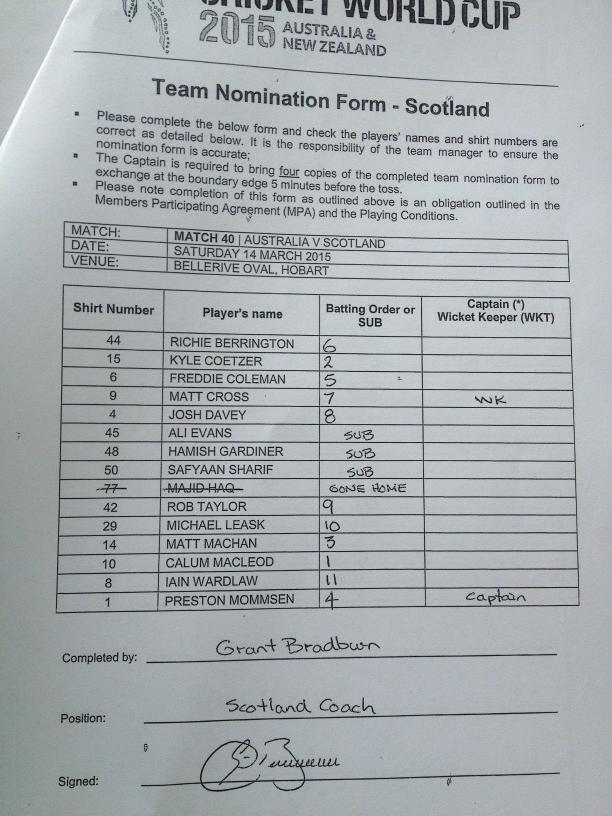
Accuracy of our preview: Not too bad at all. Davey was well and truly the surprise packet of the World Cup, and their batsman have a lot to learn.
Overall: A valuable experience, but in danger of being another false start if the big three have their way.
Sri Lanka
Good: Kumar Sangakkara is something special. While the batting in total did quite well, it was only able to do so due to Sanga's mastery of the willow. Four consecutive centuries, a feat not achieved at a World Cup before and may well not be achieved for many years to come, and yet he seemed to do it with ease. As, indeed, all his run scoring seems to be. It was a wonderful finale to his ODI career, and cricket will be poorer for not having him on the field for much longer. Joining him on the good performers list were the openers, Thirimanne and Dilshan. The two are at opposite ends of their careers, and have had the doubts that come with their respective ages, but those doubts disappeared with the weight of runs they scored.
Bad: It was a good thing their top order fired, because their middle order and bowling was as poor as the top order was good. Mathews had an okay tournament, but nothing like he's capable of. Malinga took his time to get going, and was firing in yorkers by the end, but he lacked support. Herath's injury disguised the fact he hadn't done too well to date. Overall, the middle and lower order failed when they were needed, on the rare occasions that the top order had done likewise, while the bowling simply didn't have the kind of impact the team would need to threaten the best. The next generation of bowlers will need to be far more impressive for Sri Lanka to continue as a great limited overs team.
Ugly: You would think the selectors would not even contemplate changing up the top order, given the strength of their performances during the group stages. But as is so often the case at SLC, they decided that they needed to bring in a new opener for their quarter final - someone who had played one match in the tournament, and hadn't done especially well. Poor old Kusal Perera was on a hiding to nothing, and the loss of his wicket for three set the standard for Sri Lanka in that match, losing by nine wickets.
Accuracy of our preview: Not even close, except for the result.
Overall: The last hurrah of the old, with four years now for the new brigade to cement themselves as being the right replacements.
Thursday, 19 March 2015
World Rugby confirms their internationalism
It's quite nice when something you write gets confirmed by one of the organisations you're writing about. Last month, this article of ours discussed what the point of a World Cup was, the crux being that cricket was the only sport to deny internationalism, attempting instead to keep the sport entirely in the realm of those who already play it.
One of the examples of a sport opening itself up was rugby union. Lo and behold, the head of World Rugby confirms this by saying that "As the sport grows and we conquer new markets the discussion is about looking towards expansion, rather than contraction."
And then some more harrowing logic:
"A larger World Cup would offer the chance to sell the sport into new markets, as well as increasing the potential revenues from the tournament in terms of TV deals, sponsorship, hospitality and ticket sales."
Yes, it seems the head honchos at World Rugby understand the idea that more markets = more money in the long term.
Few sports can claim so similar a background to cricket as rugby can, so to see their philosophies on expansion be worlds apart underscores just how short-sighted cricket's administrators are.
One of the examples of a sport opening itself up was rugby union. Lo and behold, the head of World Rugby confirms this by saying that "As the sport grows and we conquer new markets the discussion is about looking towards expansion, rather than contraction."
And then some more harrowing logic:
"A larger World Cup would offer the chance to sell the sport into new markets, as well as increasing the potential revenues from the tournament in terms of TV deals, sponsorship, hospitality and ticket sales."
Yes, it seems the head honchos at World Rugby understand the idea that more markets = more money in the long term.
Few sports can claim so similar a background to cricket as rugby can, so to see their philosophies on expansion be worlds apart underscores just how short-sighted cricket's administrators are.
Saturday, 14 March 2015
Book review - Second XI: Cricket in its Outposts
There's something about a World Cup that makes people look outside of their own time. Some may look back, reminiscing about past glories (especially for Australians) or past failures (especially for Englishmen). Some may look forward, wondering how the next World Cup might look, what should be changed, will it be any good?
It seems that this World Cup has tried to combine the two. There has been much written about the decision to turn the 2019 World Cup into an exclusive, ten team affair. The major justification used for it is that the best World Cup was supposedly held in 1992, and had a similar format to the one proposed.
It is with this background that Second XI: Cricket in its Outposts has been written. It is, as far as I'm aware, the first book ever to focus on a variety of national teams that don't play Test cricket, although there are a smattering of books on specific nations. It's primarily the work of Tim Wigmore, a prolific freelance writer whose work on Associate cricket over recent years has been outstanding, and Peter Miller, another freelancer, best known for his cricket podcast. There also contributions from Tim Brooks, Sahil Dutta, and the ubiquitous Gideon Haigh (which is by no means a bad thing).
The book contains, despite the name, ten chapters (like any second XI it's missing one, ho ho ho). There are four parts to the book: four chapters on the World Cup associates (Afghanistan, Ireland, Scotland, United Arab Emirates), two chapters on Associates that have since lost ODI status (Kenya, Netherlands), two chapters on rising Associates with strong homegrown talent (Nepal, Papua New Guinea), and two chapters on the potential gold mines (China, United States).
It's difficult to argue with the selections. While there are other teams that undoubtedly have stories worth telling - Canada and Bermuda have both fallen from grace in their own ways, while Hong Kong is the only current ODI nation without a chapter - these countries offer great variety. Each have their own unique stories to tell.
Cricket in Ireland took far too long to get to the point it is now. Afghanistan is the great romantic story. Kenya is a sorry tale of corruption. The Netherlands is a sorry tale of a couple of bad days ruining the near future. The United States has managed to mangle its future countless times.
Very quickly, though, a common theme becomes apparent: development of the game in these outposts is clearly being hindered by the way the ICC and the full member nations are treating them. Why has Ireland played so few full members? Why has the Netherlands lost 'ODI status' and, with it, had years of hard work undone? Why was Kenya abandoned as soon as the 2003 World Cup was over? Why is Nepal not receiving any assistance from its neighbours? Why is the ICC so insistent on not joining the IOC?
The answer to all these questions seem to come down to the short-sightedness of the current administrators, who are insistent on maximising revenues gathered amongst themselves (something they are failing at too).
Each chapter does well to tell the tale of cricket in that country, charting the history of the game from its beginning to the modern day. Particular highlights are Wigmore's chapters on Ireland and Kenya, and Dutta's on China. Dutta paints a wonderful picture of the state of the game in a country where even the most basic concepts are completely foreign. The reproduction of Haigh's essay on cricket in PNG could be seen as disappointing, but it's a thoroughly readable piece. The UAE chapter is slightly short, but at the same time doesn't leave the sense that much is being left unsaid.
The overall tone is factual, without being dull; serious, without being morose; teaching, without being preachy; and with elements of levity, without being condescending. It's a tough balancing act, but it's done well.
Miller deserves kudos for his efforts to get some words out of Sultan Zarawani, immortalised in cricket history as the man who faced Allan Donald in a hat. Wigmore likewise for the less glorious find of Maurice Odumbe, accused and banned on account of corruption, who to this day protests his innocence. Haigh's tale contains a number of characters, the best of whom is the scene-stealing Luke, and none of whom you'd expect to meet in an essay on, say, the ECB.
Above all, Second XI is a great introduction into the world of Associate and Affiliate cricket. Anyone who enjoys cricket should read this book, as it will open up a world of vivid colours that contrast remarkably with the increasingly monochrome world of full member nations.
One quote summed up the latter best, whether in or out of context: "It makes no financial sense." - Giles Clarke, ECB.
Second XI: Cricket in its Outposts is out now. You can buy it here.
It seems that this World Cup has tried to combine the two. There has been much written about the decision to turn the 2019 World Cup into an exclusive, ten team affair. The major justification used for it is that the best World Cup was supposedly held in 1992, and had a similar format to the one proposed.
It is with this background that Second XI: Cricket in its Outposts has been written. It is, as far as I'm aware, the first book ever to focus on a variety of national teams that don't play Test cricket, although there are a smattering of books on specific nations. It's primarily the work of Tim Wigmore, a prolific freelance writer whose work on Associate cricket over recent years has been outstanding, and Peter Miller, another freelancer, best known for his cricket podcast. There also contributions from Tim Brooks, Sahil Dutta, and the ubiquitous Gideon Haigh (which is by no means a bad thing).
The book contains, despite the name, ten chapters (like any second XI it's missing one, ho ho ho). There are four parts to the book: four chapters on the World Cup associates (Afghanistan, Ireland, Scotland, United Arab Emirates), two chapters on Associates that have since lost ODI status (Kenya, Netherlands), two chapters on rising Associates with strong homegrown talent (Nepal, Papua New Guinea), and two chapters on the potential gold mines (China, United States).
It's difficult to argue with the selections. While there are other teams that undoubtedly have stories worth telling - Canada and Bermuda have both fallen from grace in their own ways, while Hong Kong is the only current ODI nation without a chapter - these countries offer great variety. Each have their own unique stories to tell.
Cricket in Ireland took far too long to get to the point it is now. Afghanistan is the great romantic story. Kenya is a sorry tale of corruption. The Netherlands is a sorry tale of a couple of bad days ruining the near future. The United States has managed to mangle its future countless times.
Very quickly, though, a common theme becomes apparent: development of the game in these outposts is clearly being hindered by the way the ICC and the full member nations are treating them. Why has Ireland played so few full members? Why has the Netherlands lost 'ODI status' and, with it, had years of hard work undone? Why was Kenya abandoned as soon as the 2003 World Cup was over? Why is Nepal not receiving any assistance from its neighbours? Why is the ICC so insistent on not joining the IOC?
The answer to all these questions seem to come down to the short-sightedness of the current administrators, who are insistent on maximising revenues gathered amongst themselves (something they are failing at too).
Each chapter does well to tell the tale of cricket in that country, charting the history of the game from its beginning to the modern day. Particular highlights are Wigmore's chapters on Ireland and Kenya, and Dutta's on China. Dutta paints a wonderful picture of the state of the game in a country where even the most basic concepts are completely foreign. The reproduction of Haigh's essay on cricket in PNG could be seen as disappointing, but it's a thoroughly readable piece. The UAE chapter is slightly short, but at the same time doesn't leave the sense that much is being left unsaid.
The overall tone is factual, without being dull; serious, without being morose; teaching, without being preachy; and with elements of levity, without being condescending. It's a tough balancing act, but it's done well.
Miller deserves kudos for his efforts to get some words out of Sultan Zarawani, immortalised in cricket history as the man who faced Allan Donald in a hat. Wigmore likewise for the less glorious find of Maurice Odumbe, accused and banned on account of corruption, who to this day protests his innocence. Haigh's tale contains a number of characters, the best of whom is the scene-stealing Luke, and none of whom you'd expect to meet in an essay on, say, the ECB.
Above all, Second XI is a great introduction into the world of Associate and Affiliate cricket. Anyone who enjoys cricket should read this book, as it will open up a world of vivid colours that contrast remarkably with the increasingly monochrome world of full member nations.
One quote summed up the latter best, whether in or out of context: "It makes no financial sense." - Giles Clarke, ECB.
Second XI: Cricket in its Outposts is out now. You can buy it here.
Thursday, 5 March 2015
Wally's wonky cricketing farce
In the lead-up to the World Cup, many pundits were predicting a fairly high scoring affair. They pointed to the array of new regulations which have been brought in recently, and the lack of regulation of bats, to suggest that this World Cup would be a run-scoring bonanza.
I suspect that even they are surprised by just how bountiful the matches so far have been.
Today we saw Bangladesh, a team that has never before scored 300 at a World Cup, easily chase down a target of 319, set by Scotland, who had also never before scored 300 at a World Cup. Bangaldesh had not previously chased down a score above 250 at a World Cup.
Yesterday Australia absolutely obliterated Afghanistan, making 417, which is the highest total ever at a World Cup, and winning by 275 runs, the biggest margin ever at a World Cup.
Four of the ten highest totals in World Cup history have been made at this World Cup. Three of the seven successful run chases of 300+ in World Cups have been in this one.
What's really noticeable about the three successful 300+ run chases is how easy they were. At no point did Ireland, Sri Lanka or Bangladesh seem like they were in serious danger of losing the match.
Despite this, Bangladesh's 322 is only the tenth highest score at this World Cup. There have been sixteen scores of 300+ in the first innings so far, three of which were over 400.
But the most distressing statistic of all has been the average runs scored from overs 40-50. This currently sits at over 100. Yes, that is an average of ten runs an over in the last ten overs across an entire World Cup. Little wonder 300 is increasingly being viewed as a par score, when teams are scoring that many runs so quickly and so consistently.
And what is the reason for this?
It's all thanks to one man.
 The man on the left is Wally Edwards. He is the quiet one of the Big Three chairmen - all of whom will soon be out of their board positions for one reason or another - and he has some ideas on which way ODIs should be going. Some of them are worth discussing, particularly his idea that ODIs should be based around the World Cup, as the World Cup is what gives them context.
But today we'll be looking at the ideas he's already had implemented: two new balls and tighter field restrictions.
The idea of having a new ball from each end had been mooted here and there for a number of years before it came in. It replaced a fairly unusual situation before when the white ball would be replaced around two thirds of the way through an innings. However, it also necessarily changed the nature of the innings. Previously, the ball would swing for around ten to fifteen overs (if it was swinging at all), and then the shine would come off, making batting easier. Then, as the ball got even older, reverse swing would come into the picture, with both the first and second balls.
Two new balls completely changed that dynamic. Instead, the ball could be swinging for twenty to thirty overs at the start of the innings, and then doing not much for the remainder. Reverse swing ceases to be a factor entirely, as the ball doesn't wear enough. It's little wonder that India was unimpressed with the idea.
So, how does this change the game? Well, it means two scenarios are more likely. First, the bowling team can tear through the entire opposition. If the ball is moving around a lot, it will be moving for at least half the innings. Chances are, if they're a good bowling team, they can take most of the opposition's wickets by the time the ball ceases to be as potent. Second, the batting team can rack up a higher score. If the ball isn't doing much, there is no threat of reverse swing to worry about at the back end of the innings. This means that teams that save their wickets early on can go ballistic in the last twenty overs, knowing that the bowling won't be throwing up any surprises.
This is where the new fielding restrictions come into play. Previously, a fielding captain would at least feel somewhat secure in the knowledge that if the batsmen were swinging the bat, he could have five men in the deep, ready to catch any mis-hits. The simple change of forcing him to only have four men out in the last ten completely destroys that safety net. Four men cannot hope to cover the 360 degrees that batsmen can hit in. Theoretically, having five men inside the circle could keep the pressure on batsmen. But, if the batting team knows what they're doing, they will have enough wickets in hand that they will be hitting the ball over the fielder's heads, thus rendering them useless.
We have seen a few occasions where teams have fallen into a rut in the last ten overs, but this has been far outweighed by teams putting the game out of reach for their opponents by scoring at ten runs an over.
So, why have these clearly lopsided regulations been brought in? Well, according to Dan Brettig, Edwards believes that the regulations for ODIs should encourage attacking cricket; that is, more wickets and more runs. Certainly, there are games with lots of runs, and games with lots of wickets.
Unfortunately, these very rarely happen together, and what these regulations have actually done is kill the contests. It's hardly surprising that the two best games of the cup so far have involved totals of less than 250 being chased down with only one wicket in hand.
For the most part, it has been a dull affair with massive first innings scores, and occasionally some massive second innings scores too.
And the worst thing is, it's not even close to being over yet.
I suspect that even they are surprised by just how bountiful the matches so far have been.
Today we saw Bangladesh, a team that has never before scored 300 at a World Cup, easily chase down a target of 319, set by Scotland, who had also never before scored 300 at a World Cup. Bangaldesh had not previously chased down a score above 250 at a World Cup.
Yesterday Australia absolutely obliterated Afghanistan, making 417, which is the highest total ever at a World Cup, and winning by 275 runs, the biggest margin ever at a World Cup.
Four of the ten highest totals in World Cup history have been made at this World Cup. Three of the seven successful run chases of 300+ in World Cups have been in this one.
What's really noticeable about the three successful 300+ run chases is how easy they were. At no point did Ireland, Sri Lanka or Bangladesh seem like they were in serious danger of losing the match.
Despite this, Bangladesh's 322 is only the tenth highest score at this World Cup. There have been sixteen scores of 300+ in the first innings so far, three of which were over 400.
But the most distressing statistic of all has been the average runs scored from overs 40-50. This currently sits at over 100. Yes, that is an average of ten runs an over in the last ten overs across an entire World Cup. Little wonder 300 is increasingly being viewed as a par score, when teams are scoring that many runs so quickly and so consistently.
And what is the reason for this?
It's all thanks to one man.


But today we'll be looking at the ideas he's already had implemented: two new balls and tighter field restrictions.
The idea of having a new ball from each end had been mooted here and there for a number of years before it came in. It replaced a fairly unusual situation before when the white ball would be replaced around two thirds of the way through an innings. However, it also necessarily changed the nature of the innings. Previously, the ball would swing for around ten to fifteen overs (if it was swinging at all), and then the shine would come off, making batting easier. Then, as the ball got even older, reverse swing would come into the picture, with both the first and second balls.
Two new balls completely changed that dynamic. Instead, the ball could be swinging for twenty to thirty overs at the start of the innings, and then doing not much for the remainder. Reverse swing ceases to be a factor entirely, as the ball doesn't wear enough. It's little wonder that India was unimpressed with the idea.
So, how does this change the game? Well, it means two scenarios are more likely. First, the bowling team can tear through the entire opposition. If the ball is moving around a lot, it will be moving for at least half the innings. Chances are, if they're a good bowling team, they can take most of the opposition's wickets by the time the ball ceases to be as potent. Second, the batting team can rack up a higher score. If the ball isn't doing much, there is no threat of reverse swing to worry about at the back end of the innings. This means that teams that save their wickets early on can go ballistic in the last twenty overs, knowing that the bowling won't be throwing up any surprises.
This is where the new fielding restrictions come into play. Previously, a fielding captain would at least feel somewhat secure in the knowledge that if the batsmen were swinging the bat, he could have five men in the deep, ready to catch any mis-hits. The simple change of forcing him to only have four men out in the last ten completely destroys that safety net. Four men cannot hope to cover the 360 degrees that batsmen can hit in. Theoretically, having five men inside the circle could keep the pressure on batsmen. But, if the batting team knows what they're doing, they will have enough wickets in hand that they will be hitting the ball over the fielder's heads, thus rendering them useless.
We have seen a few occasions where teams have fallen into a rut in the last ten overs, but this has been far outweighed by teams putting the game out of reach for their opponents by scoring at ten runs an over.
So, why have these clearly lopsided regulations been brought in? Well, according to Dan Brettig, Edwards believes that the regulations for ODIs should encourage attacking cricket; that is, more wickets and more runs. Certainly, there are games with lots of runs, and games with lots of wickets.
Unfortunately, these very rarely happen together, and what these regulations have actually done is kill the contests. It's hardly surprising that the two best games of the cup so far have involved totals of less than 250 being chased down with only one wicket in hand.
For the most part, it has been a dull affair with massive first innings scores, and occasionally some massive second innings scores too.
And the worst thing is, it's not even close to being over yet.
Thursday, 26 February 2015
Samiullah Shenwari, the warrior king
The Afghanistan national cricket team has been cricket's feel good story over the past few years. As they have continued to play and win at international level, more has been written about them.
The first player people paid attention to was Mohammad Shahzad. Afghanistan needed something to really make people take notice, and here was a batsman with talent, flair, and something called the 'helicopter shot'. When Afghanistan played in their first World T20, there he was, playing his shots, making people take notice.
But Shahzad has been moved out of the first XI. Not because he isn't talented, or capable with the bat, but because he isn't fit enough. He has many years left to change this, but at the moment he seems to have been only the spark to get his nation noticed.
Next to be noticed was Hamid Hassan. Hassan is a classic fast bowler, sporting a headband and war paint. His focus is purely on taking wickets. He is probably the best bowler not playing Test cricket. He is an absolute joy to watch. But like a classic fast bowler, he gets injured regularly. So when Afghanistan is playing, he isn't always there.
So next was Mohammad Nabi. Nabi, unlike Shahzad and Hassan, is never out of the team. He is never injured, and does something important pretty much every match, either with a stabilising fifty, or an economical spell of off-spin. He's also their captain now. Nabi is the face of Afghan cricket, so how can you not pay attention to him?
The beauty of television has presented another Afghan player to the world: Shapoor Zadran. Shapoor is also a classic fast bowler, but in a different sense. If Hassan is a beast, then Shapoor is a beauty. He is magnificently tall, with glorious hair and a run-up that defies the modern age of precise science. He is an attention magnet.
So, that's four players to write about, four players to define Afghan cricket.
But there's one more player. One who has never had the attention these four have had. One who has made his way up the ranks from useful player to absolute necessity.
He is a player who demonstrates both aggression and calm, and seems able to use these both where appropriate, an absolutely vital attribute in international cricket. He has the heart of warrior, and the mind of a ruler.
His name is Samiullah Shenwari.
--------------------------------------------------
Shenwari played U17s for Afghanistan, along with many of his current national teammates. He was their high scorer in their loss to Oman at the ACC U17s Cup in 2004, and also took a wicket.
He played in the 2006 ACC Trophy in 2006. Sometimes he batted up the order, sometimes he batted down the order. Sometimes he would be ten overs and take a couple of wickets. Sometimes he wouldn't bowl at all. In the semi-final he batted at nine and did not bowl, in the third place play-off he batted at four and bowled five overs.
When Afghanistan began their push towards the 2011 World Cup in 2008, they were in division five of the World Cricket League. Afghanistan won the division. Shenwari scored two runs across three innings (batting at seven and eight), and bowled two balls.
In division four, which Afghanistan won, he batted at eight and nine, scoring 49 runs in six matches. He also took three wickets.
In division three, which Afghanistan came second in, he scored 113 runs in four innings, including a fifty, still batting at eight. He also took seven wickes.
Come the World Cup Qualifier, he was still batting at eight, scoring 194 runs, and bowling a bit, taking eight wickets.
When Afghanistan played their Intercontinental Cup match against the Netherlands, he batted at eight. When Afghanistan played their first ever ODI, against the same team, he batted at eight.
But then, in their second ODI, Shenwari got promoted to five in a search for quick runs. It worked, and Afghanistan chased down 232, with Shenwari scoring 30* off 39 deliveries.
He went back down to eight for their next ODIs and the first few matches of WCL division one. Then Afghanistan found themselves in a tight spot early against Kenya, so Shenwari came in at four. He scored a match winning 82 off 118.
Again, he went back down the order, mainly in the team for his useful leg-spin. But something had sparked, because every now and then he would come up from his position at eight or nine, and play a decent innings. Importantly, it was rarely a quickfire cameo. He was more likely to make his 30 at a strike rate of 60 than at a strike rate of 140.
By 2013 he had been nudged up to number seven, where he played a match winning innings of 81 against Bangladesh, and was pushed up to number six. After one innings there, he went back to eight. But the match-winner at seven may have been what caught the eye of the new Afghan coach.
Andy Moles arrived as Afghanistan's coach in 2014. Their first series following his appointment was against Zimbabwe. Shenwari found himself batting at five. And the thing was, he kept scoring runs. After Mohammad Nabi showed his batting to be just as reliable, they were swapped. But the two have stayed within one position of each other since then.
Then, in January 2015, Shenwari demonstrated everything that makes him so important to Afghanistan. They had defeated Scotland easily in the first match of a short tri-series. In the rematch, they fell apart, bowled out for 63, losing by 150 runs.
In Afghanistan's next match, Shenwari set about proving that Afghanistan could bat out a match, even if he had to do it himself. He ground out 50 from 96. Najibullah Zadran hit 83 from 50, an innings that won Afghanistan the match. Samiullah's innings seems unremarkable in comparison. But it was a foundation on which to build. That is what Shenwari does.
--------------------------------------------------
In a team that is renowned more for big hitting than grinding, Shenwari's application is an anomaly. He has a strike rate just under 70, despite an average of 38.51. This seems quite low. It seems even lower when you consider he's spent much of his career as a lower order batsman, in the team for his bowling more than his batting. His record batting up the order is actually quite remarkable: 754 runs @ 68.54. His lowest score at four is 38. At five he has made two single digit scores, and then a next lowest score of 39*. That is the kind of batting a team can build around.
It is the kind of batting that wins matches too.
When Shenwari came in at number four today against Scotland, Afghanistan were 2/45. With the help of Javed Ahmadi, Shenwari took the score to 2/85. Then, having just made his 50, Ahmadi had a wild swing at a Richie Berrington delivery, sent the ball in the air, and was out. The next four wickets fell for twelve runs. Shenwari could only calmly block, take singles and watch from the other end as the team fell around him.
Dawlat Zadran put on a 35 run partnership with Shenwari, before doing the same thing Ahmadi did, with the same result. Shenwari was livid. His calm demeanour was broken for those few seconds, and he seemed like the rest of his team - passionate and emotional. In many ways, Afghanistan seems like Pakistan from years ago.
But then he calmed again, reset, and got to working with the beast, Hamid Hassan. For the next twelve overs, the two set about bringing down the runs required. Hamid would block and leave and take the single where appropriate. Shenwari would do the same, but also take some boundaries from time to time. When he did this, it never seemed wild or out of control. It was always well controlled aggression. Despite the odds, Shenwari looked like he could single-handedly carry his team home.
Majid Haq came on in the 46th over, having gone for 26 off his first nine overs. Afghanistan needed 38 from 24. Haq came around the wicket to Shenwari for the first time in the match.
The first ball was deposited over cow corner for six.
The second ball was a wide.
The third ball was mistimed for six over square leg.
The fourth ball was defended for no runs.
That is the difference with Shenwari. Most other Afghan batsmen would've tried another boundary. You cannot imagine Shahzad blocking a ball after hitting two sixes.
The fifth ball went for another six over mid wicket.
Haq came over the wicket.
The sixth ball was caught at deep mid wicket as Shenwari went for another six. He was on 96.
Shenwari seemed like his teammates again. After he walked of the field, he threw his bat down, and sat down with his helmet on, watching the game, distraught at getting out. Had he lost his team the game? Had that temporary rush of blood undone his 176 minutes at the crease?
Shenwari remained perched over the game until the end, hoping that two bowlers with batting averages of five could get his team home.
--------------------------------------------------
In the end, he won his team the game. Shapoor Zadran knocked a four from Iain Wardlaw off the third ball of the final over. Shapoor and Hassan sprinted towards the boundary, arms in the air, overjoyed at their victory.
All the photos that will be in the papers tomorrow, and in the history books detailing Afghanistan's first World Cup victory, will be of Shapoor with his arms aloft.
There won't be many of Shenwari. He wasn't there at the end. He didn't make a century. He didn't even bowl. But he did everything needed, and was the foundation of the innings.
He fought and scrapped and stayed in the contest, fighting even when he was on his haunches. He was a warrior.
But he was also cool and calm. When he scored boundaries, they were majestic. He was in control. You could believe that he would do the seemingly impossible. He was a king.
Were he only a stodgy batsman, he would not bowl leg spin. Using the wrist to spin the ball is more art than science.
But were he only an okay leg-spinner, he would not grind. He would not apply himself to every ball, waiting for the opportunity to put the team on his back.
He is something greater than that. He may even be something great.
So tonight, as the people of Afghanistan revel in their team's victory, we can imagine that they, at least, will be celebrating the heroics of the man who is now their greatest ever run scorer.
He is Samiullah Shenwari, warrior and king.
The first player people paid attention to was Mohammad Shahzad. Afghanistan needed something to really make people take notice, and here was a batsman with talent, flair, and something called the 'helicopter shot'. When Afghanistan played in their first World T20, there he was, playing his shots, making people take notice.
But Shahzad has been moved out of the first XI. Not because he isn't talented, or capable with the bat, but because he isn't fit enough. He has many years left to change this, but at the moment he seems to have been only the spark to get his nation noticed.
Next to be noticed was Hamid Hassan. Hassan is a classic fast bowler, sporting a headband and war paint. His focus is purely on taking wickets. He is probably the best bowler not playing Test cricket. He is an absolute joy to watch. But like a classic fast bowler, he gets injured regularly. So when Afghanistan is playing, he isn't always there.
So next was Mohammad Nabi. Nabi, unlike Shahzad and Hassan, is never out of the team. He is never injured, and does something important pretty much every match, either with a stabilising fifty, or an economical spell of off-spin. He's also their captain now. Nabi is the face of Afghan cricket, so how can you not pay attention to him?
The beauty of television has presented another Afghan player to the world: Shapoor Zadran. Shapoor is also a classic fast bowler, but in a different sense. If Hassan is a beast, then Shapoor is a beauty. He is magnificently tall, with glorious hair and a run-up that defies the modern age of precise science. He is an attention magnet.
So, that's four players to write about, four players to define Afghan cricket.
But there's one more player. One who has never had the attention these four have had. One who has made his way up the ranks from useful player to absolute necessity.
He is a player who demonstrates both aggression and calm, and seems able to use these both where appropriate, an absolutely vital attribute in international cricket. He has the heart of warrior, and the mind of a ruler.
His name is Samiullah Shenwari.
--------------------------------------------------
Shenwari played U17s for Afghanistan, along with many of his current national teammates. He was their high scorer in their loss to Oman at the ACC U17s Cup in 2004, and also took a wicket.
He played in the 2006 ACC Trophy in 2006. Sometimes he batted up the order, sometimes he batted down the order. Sometimes he would be ten overs and take a couple of wickets. Sometimes he wouldn't bowl at all. In the semi-final he batted at nine and did not bowl, in the third place play-off he batted at four and bowled five overs.
When Afghanistan began their push towards the 2011 World Cup in 2008, they were in division five of the World Cricket League. Afghanistan won the division. Shenwari scored two runs across three innings (batting at seven and eight), and bowled two balls.
In division four, which Afghanistan won, he batted at eight and nine, scoring 49 runs in six matches. He also took three wickets.
In division three, which Afghanistan came second in, he scored 113 runs in four innings, including a fifty, still batting at eight. He also took seven wickes.
Come the World Cup Qualifier, he was still batting at eight, scoring 194 runs, and bowling a bit, taking eight wickets.
When Afghanistan played their Intercontinental Cup match against the Netherlands, he batted at eight. When Afghanistan played their first ever ODI, against the same team, he batted at eight.
But then, in their second ODI, Shenwari got promoted to five in a search for quick runs. It worked, and Afghanistan chased down 232, with Shenwari scoring 30* off 39 deliveries.
He went back down to eight for their next ODIs and the first few matches of WCL division one. Then Afghanistan found themselves in a tight spot early against Kenya, so Shenwari came in at four. He scored a match winning 82 off 118.
Again, he went back down the order, mainly in the team for his useful leg-spin. But something had sparked, because every now and then he would come up from his position at eight or nine, and play a decent innings. Importantly, it was rarely a quickfire cameo. He was more likely to make his 30 at a strike rate of 60 than at a strike rate of 140.
By 2013 he had been nudged up to number seven, where he played a match winning innings of 81 against Bangladesh, and was pushed up to number six. After one innings there, he went back to eight. But the match-winner at seven may have been what caught the eye of the new Afghan coach.
Andy Moles arrived as Afghanistan's coach in 2014. Their first series following his appointment was against Zimbabwe. Shenwari found himself batting at five. And the thing was, he kept scoring runs. After Mohammad Nabi showed his batting to be just as reliable, they were swapped. But the two have stayed within one position of each other since then.
Then, in January 2015, Shenwari demonstrated everything that makes him so important to Afghanistan. They had defeated Scotland easily in the first match of a short tri-series. In the rematch, they fell apart, bowled out for 63, losing by 150 runs.
In Afghanistan's next match, Shenwari set about proving that Afghanistan could bat out a match, even if he had to do it himself. He ground out 50 from 96. Najibullah Zadran hit 83 from 50, an innings that won Afghanistan the match. Samiullah's innings seems unremarkable in comparison. But it was a foundation on which to build. That is what Shenwari does.
--------------------------------------------------
In a team that is renowned more for big hitting than grinding, Shenwari's application is an anomaly. He has a strike rate just under 70, despite an average of 38.51. This seems quite low. It seems even lower when you consider he's spent much of his career as a lower order batsman, in the team for his bowling more than his batting. His record batting up the order is actually quite remarkable: 754 runs @ 68.54. His lowest score at four is 38. At five he has made two single digit scores, and then a next lowest score of 39*. That is the kind of batting a team can build around.
It is the kind of batting that wins matches too.
When Shenwari came in at number four today against Scotland, Afghanistan were 2/45. With the help of Javed Ahmadi, Shenwari took the score to 2/85. Then, having just made his 50, Ahmadi had a wild swing at a Richie Berrington delivery, sent the ball in the air, and was out. The next four wickets fell for twelve runs. Shenwari could only calmly block, take singles and watch from the other end as the team fell around him.
Dawlat Zadran put on a 35 run partnership with Shenwari, before doing the same thing Ahmadi did, with the same result. Shenwari was livid. His calm demeanour was broken for those few seconds, and he seemed like the rest of his team - passionate and emotional. In many ways, Afghanistan seems like Pakistan from years ago.
But then he calmed again, reset, and got to working with the beast, Hamid Hassan. For the next twelve overs, the two set about bringing down the runs required. Hamid would block and leave and take the single where appropriate. Shenwari would do the same, but also take some boundaries from time to time. When he did this, it never seemed wild or out of control. It was always well controlled aggression. Despite the odds, Shenwari looked like he could single-handedly carry his team home.
Majid Haq came on in the 46th over, having gone for 26 off his first nine overs. Afghanistan needed 38 from 24. Haq came around the wicket to Shenwari for the first time in the match.
The first ball was deposited over cow corner for six.
The second ball was a wide.
The third ball was mistimed for six over square leg.
The fourth ball was defended for no runs.
That is the difference with Shenwari. Most other Afghan batsmen would've tried another boundary. You cannot imagine Shahzad blocking a ball after hitting two sixes.
The fifth ball went for another six over mid wicket.
Haq came over the wicket.
The sixth ball was caught at deep mid wicket as Shenwari went for another six. He was on 96.
Shenwari seemed like his teammates again. After he walked of the field, he threw his bat down, and sat down with his helmet on, watching the game, distraught at getting out. Had he lost his team the game? Had that temporary rush of blood undone his 176 minutes at the crease?
Shenwari remained perched over the game until the end, hoping that two bowlers with batting averages of five could get his team home.
--------------------------------------------------
In the end, he won his team the game. Shapoor Zadran knocked a four from Iain Wardlaw off the third ball of the final over. Shapoor and Hassan sprinted towards the boundary, arms in the air, overjoyed at their victory.
All the photos that will be in the papers tomorrow, and in the history books detailing Afghanistan's first World Cup victory, will be of Shapoor with his arms aloft.
There won't be many of Shenwari. He wasn't there at the end. He didn't make a century. He didn't even bowl. But he did everything needed, and was the foundation of the innings.
He fought and scrapped and stayed in the contest, fighting even when he was on his haunches. He was a warrior.
But he was also cool and calm. When he scored boundaries, they were majestic. He was in control. You could believe that he would do the seemingly impossible. He was a king.
Were he only a stodgy batsman, he would not bowl leg spin. Using the wrist to spin the ball is more art than science.
But were he only an okay leg-spinner, he would not grind. He would not apply himself to every ball, waiting for the opportunity to put the team on his back.
He is something greater than that. He may even be something great.
So tonight, as the people of Afghanistan revel in their team's victory, we can imagine that they, at least, will be celebrating the heroics of the man who is now their greatest ever run scorer.
He is Samiullah Shenwari, warrior and king.
Tuesday, 17 February 2015
What is a World Cup for?
Of all the
sports in the world, not many are team sports with a large enough
following to appear on free-to-air television somewhere in the world.
Each of the biggest holds a world tournament every few years, and I
believe these are worth comparing. I will look at association
football, cricket, hockey, rugby (union) and rugby league. There are
other sports that could also be included in this, but these five have
very similar origins, so I'll limit it to them.
2015 sees
two of these sports hold their world cup. Cricket's starts on
Saturday, while rugby's begins in September. There has been some
discussion in the cricketing world about the International Cricket
Council's decision to cut the number of teams taking part in their
next world cup to ten, down from fourteen this year. The main reason
they give is that they believe the CWC should be a tournament for the
best of the best. With this in mind, let us examine how true it is
that sporting world cups are only meant to be for the absolute best
teams to play in.
Governing
body and membership
Each of these sports has one central governing body.
FIFA is the governing body for association football. It currently has
209 members, all of which are part of one of six continental
confederations. Each confederation hosts a tournament of its own
every four years, and members often work together to achieve results
for their region within the FIFA congress. All members have equal
voting rights. The congress elects the FIFA executive committee every
four years. In order to join FIFA, a football association must be
responsible for overseeing football in that country. There are only
seven sovereign states in the world which are not members of FIFA, of
which one (the UK) is represented by four teams.
The ICC is the governing body for cricket. It currently has ten full
members, 37 associate members, and 59 affiliate members. Associates
and affiliates are organised into regional bodies, some of which are
run by the ICC, and some of which are independent and run events on
behalf of the ICC. Each regional body has, at some point, organised
tournaments, but the regularity and scope of these events varies. The
ten full member nations are the only ones with full voting rights.
The other 96 members have three collective votes. The ICC executive
committee contains a permanent member from Australia, England and
India, and two rotating members from the other full member nations.
In order to join the ICC as an affiliate, a cricket association must
meet certain criteria. Harsher criteria must be then met at least
three years later to become an associate. Becoming a full member
nation has no clear criteria.
The FIH is the governing body for hockey. It currently has 128
members, all of which are part of one of five continental
federations. Each federation hosts a tournament of its own every four
years. All members have equal voting rights. The members vote for the
executive committee, of which five members will represent their
federation on the committee as well. In order to join the FIH, an
association must prove that it is the sole governing body for hockey
in its nation.
World Rugby is the governing body for rugby union. It currently has
100 members, and 17 associate members, all of which are part of of
regional unions. Some members of regional unions are not part of
World Rugby. Each regional unions runs tournaments in their own
region. Voting rights on the Council are unequally divided.
Foundation members have two votes, four long term members have one
vote, and the regional associations have one vote. No other members
have votes. The executive committee is voted in by the council. In
order to join World Rugby, a union must first join its regional union
as an associate member. After one year, they can become a full member
of the regional union. After two more years, they can become an
Associate member of World Rugby. After another two years, they can
become a full member.
The RLIF is the governing body for rugby league. It currently has 45
members, divided into two federations. All members have voting
rights. The executive committee contains two members from each of
Australia, England and New Zealand, while the other four members are
elected by the two federations. In order to join the IRLF, an
association must meet certain criteria, first to become an observer,
then an affiliate, then an associate (though this is only receiving
approval from the full members), then a full member.
So, from this we can see that there are two schools of thought
regarding membership – open and closed. Association football and
hockey are open; a national governing body simply has to prove that
it the sole governing body in its country for that sport, and it will
be granted full membership. Cricket, rugby and league are closed;
members must fulfil certain criteria to join, and even then they
don't immediately become full members after joining. However, both
the rugby codes have a clear path to full membership. In union, a
country could become a full member only five years after joining,
although this doesn't include voting rights. In league, there is no
clear time frame, only a certain set of standards that must be met to
get the approval of the full members, but once this hurdle is passed
new members have full voting rights. In cricket, neither of these is
the case. Associate members have no clear path to becoming full
members. As it stands, football contains the most members with some
degree of power, and cricket the least. How does this translate in
global tournaments?
World
Cup
The first FIFA World Cup was held in Uruguay in 1930. It featured
thirteen teams, including seven from South America, four from Europe
and two from North America. The most recent World Cup was held in
Brazil in 2014. It featured 32 teams, hailing from every continent.
Qualification tournaments have been held since the second World Cup
in 1934. Seventy-seven teams have played at least one World Cup, with
a further six having appeared as more than one nation. Only eight
teams have won a World Cup, and of these three (Brazil, Germany,
Italy) have won thirteen of the twenty to have been played. A further
four nations have only been runner-up. Plans to expand it further
have been mooted.
The first ICC Cricket World Cup was held in England in 1975. It
featured eight teams, including the six Test playing nations of the
time, along with Sri Lanka and an East African team. The most recent
World Cup is being held in 2015 in Australia and New Zealand. It
features fourteen teams from four continents and the Caribbean.
Qualification has been automatic for Test playing nations, while
associates have played qualification tournaments since 1996. Twenty
teams have played at least one World Cup. Five teams have won a World
Cup, with Australia winning four out of ten. England is the only team
to finish as runner-up without ever being champions. The ICC plans to
reduce the number of teams to ten in 2019.
The first Hockey World Cup was held in Spain in 1971. It featured ten
teams from every continent bar North America. The most recent World
Cup was held in 2014 in the Netherlands. It featured twelve teams
from the same five continents. Qualification is based on a mix of
regional tournaments and world league results. Twenty-four teams have
played at least one World Cup. Five teams have won a World Cup, with
three teams (Pakistan, Australia, Netherlands) winning ten of the
thirteen to be held. Two teams have only been runner-up. The FIH
plans to expand the number of teams to 16 in 2018, and possibly 24 in
2022.
The first Rugby World Cup was held in Australia and New Zealand in
1987. It featured sixteen teams, including the seven IRFB member
nations. The most recent World Cup is being held in 2015 in 2015 in
England. It features twenty teams from every continent. Qualification
is based on results at the previous World Cup, as well as regional
tournaments. Twenty-five teams have played at least one World Cup.
Four teams have won a World Cup, with France only finishing as
runner-up. There are no official plans to expand the amount of teams
in the near future.
The first Rugby League World Cup was held in France in 1954. It
featured four teams (the hosts, Great Britain, Australia and New
Zealand). The most recent World Cup was held in England and Wales in
2013. It featured fourteen teams from three continents. Qualification
is based on previous World Cup results, regional tournaments and a
qualifier. Nineteen teams have played at least one World Cup, four of
which played as another nation (Great Britain) previously. Three
teams have won a World Cup, and two teams have finished as runner-up
without being champions.
What we can see here is confirmation of the Football World Cup being
the greatest of them all. It is surely the goal of every sport to be
as big as association football, and the sheer number of teams that
have played at a FIFA World Cup compared to the other four
demonstrates just how big it is. But despite fifty more teams having
played at the FWC compared to the next best (RWC), only three more
teams have actually won an FWC compared to their next nearest.
Indeed, the top echelon of football seems little bigger than in the
other sports. In fact, if World Cup tournaments are only meant to be
for the best of the best, none of the sports have done a very good
job. Every sport currently includes teams in the World Cup that have
no chance of winning. If we assume every previous FWC winner plays in
a 32 team WC, that leaves ¾ of teams not having previously won and,
presumably, being highly unlikely to win the next time around. And
there are already proposals to expand the FWC further! Why could they
possibly want more losers playing?
It's worth noting that only one of these sports has, at any point,
reduced the number of teams from one tournament to the next. That
sport is cricket, which peaked with sixteen teams in 2007, and has
since reduced the teams to fourteen, and soon to ten. As mentioned
above, the main reason given for this is to ensure that only 'the
best of the best' are playing in the major tournament. While this is
difficult to believe on its own, given what we know about the people
controlling cricket at the moment, it is clear that it doesn't really
stack up when compared with other sports either. These other sports
must have good reason to pursue expansion, rather than contraction.
The most common reason given seem to be that it is a) a way to expand
the game and b) representative of the global nature of the sport. The
expansion of the game does not seem to necessarily be tied to
on-field results – the winners of the FIFA World Cup historically
aren't overly diverse – but, crucially, the game is watched in far
more countries than any other. Nations can dream of world cup glory,
no matter how far-fetched. Hockey is making a belated push towards
expansion on the back of a fairly even top 20 ranked nations (or so
they claim). Rugby league has consistently talked about international
expansion over the past two decades, although it has struggled to
gain traction outside of the Commonwealth. Union has been more
successful, and desperately wants to be seen as a genuinely global
sport, despite the somewhat slow internal shifts.
What all these sports have in common when it comes to being a global
game is that they are genuinely pushing to be seen as global sports,
open to all and welcoming those who aren't quite as good as the
absolute best, in the hope that one day the new teams will match the
old champions.
And then there's cricket.
Here we have a sport which can claim to be the second most popular
sport in the world, which has a long history, which any fan can tell
you is a great and unique game to watch...and which is seemingly
absolutely rock solid in its resolution not
to expand. It is both odd and self-defeating.
If it's ultimately all about money,
it doesn't explain why other sports are so eager to expand the game
now. Don't they need money too? Certainly, money seems to be a part
of it. But the absolute centrality of the 'big three' seems to be
equally about power, about the continuation of an elite in the sport
for reasons best known to those within, and not to be told to those
outside.
At least, you'd hope it is, because
the alternative is that the administrators simply have no idea of
what they're doing, or how to plan for the future, or have any
concept of growth, and if that is the case then cricket will be in a
deep rut in not too many years from now.
You will know it is in that rut when
Australia, England and India are playing yearly tri-series against
each other, and the administrators are wondering why crowds are so
poor, and why the television rights are worth less than they were
when those other countries were playing.
Subscribe to:
Posts (Atom)